

NCHU Achieves Its Best-Ever Ranking in QS Sustainability 2026
2025-12-01
興新聞張貼者
Unit秘書室
3,807
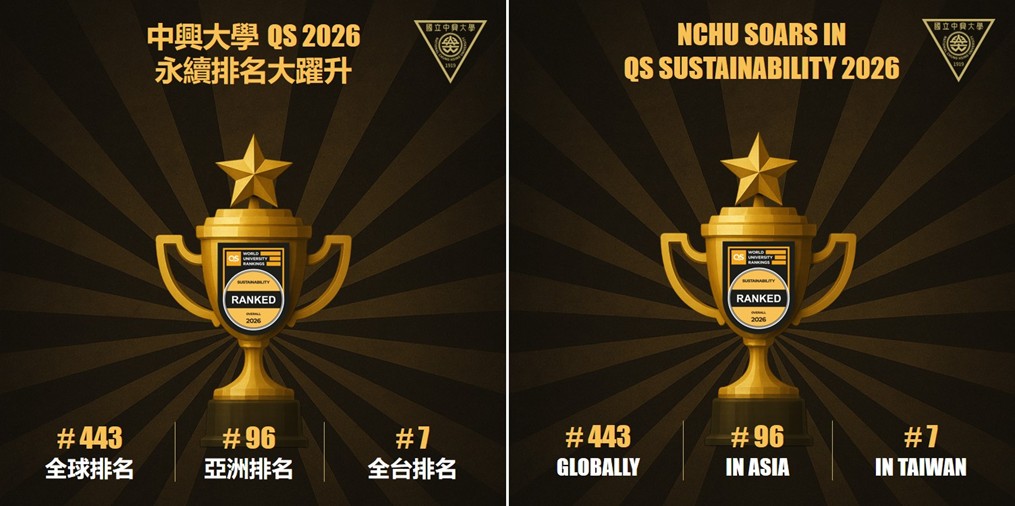
National Chung Hsing University (NCHU) has delivered another strong performance in the QS Sustainability Rankings 2026, placing 443rd globally, 96th in Asia, and 7th in Taiwan among 2,002 participating universities—its best result since the university joined the sustainability ranking.
The QS Sustainability Rankings evaluate universities’ contributions to global sustainable development across three major lenses: Environmental Impact, Social Impact, and Governance, comprising a total of nine indicators. This year, NCHU demonstrated improvement across all three lenses, with particularly notable gains in Environmental Impact and Governance, reflecting the university’s comprehensive and sustained advancement in sustainability.
Environmental Impact: Showcasing Sustainability Education, Research Excellence, and Net-Zero Campus Achievements
In the Environmental Impact lens, NCHU ranked 292nd globally, 62nd in Asia, and 6th in Taiwan. The university performed particularly well in Environmental Education, ranking 164th globally, 32nd in Asia, and 4th in Taiwan—a testament to the breadth and depth of NCHU’s sustainability curriculum, interdisciplinary general education programs, and micro-credential pathways. In recent years, NCHU has also systematically integrated AI and sustainability topics across academic offerings, equipping students with comprehensive sustainability competencies.
NCHU continues to demonstrate international research leadership in sustainable agriculture, climate action, ecological conservation, biodiversity, circular economy, and low-carbon materials. Through university-level research centers and featured area research centers, NCHU has established an integrated, cross-disciplinary sustainability research network that strengthens SDG-aligned research capacity and connects the university’s scholarship to global academic developments.
The university’s Net-Zero Campus Initiative has also received strong recognition. NCHU’s campus microgrid and energy-storage system—supported by a NT$100 million Taipower grant—integrates renewable energy facilities, carbon-neutral demonstration zones, and the Soil Carbon Sink Research and Promotion Center. Together with Taiwan’s largest FSC-certified university forest holdings, NCHU continues to advance natural carbon sinks and ecological conservation, leading to significant improvements in the Environmental Impact indicators.
Social Impact: Strengthening Health, Equity, and Industry Engagement
NCHU showed notable gains in the Social Impact lens, with strong performance in Health and Wellbeing (378th globally; 54th in Asia; 8th in Taiwan) and Employability and Opportunities (490th globally; 148th in Asia; 9th in Taiwan).
The university has established a comprehensive mental-health and student-support ecosystem, including college-level advisors, evening counseling services, campus-resilience programs, medical support partnerships, mental-health leave, self-care training, and academic-alert systems—ensuring timely assistance for students across different learning stages.
To promote educational equity, NCHU has long implemented the Hsing-Yi Project, diversified admissions pathways, and extensive support for economically or culturally disadvantaged students, strengthening its performance in the Equality and Impact of Education indicators.
In industry engagement, NCHU leverages the strengths of the Central Taiwan technology corridor to operate an industry mentor program, cross-border internships, cross-college career-matching services, and a large-scale annual career fair, while deepening collaborations with global partners such as UC Davis and Texas A&M University to enhance students’ international mobility and competitiveness.
The university’s USR (University Social Responsibility) initiatives—spanning animal welfare, river-basin culture, ecological sustainability, elderly care, and indigenous health—continue to receive national and international recognition, including the prestigious 2024 National Sustainable Development Award.
Governance: Elevating Transparency, DEI, and a Human-Centered Campus Framework
In the Governance lens, NCHU ranked 324th globally, 66th in Asia, and 9th in Taiwan. The university’s governance framework builds on a PDCA-based decision-making cycle and a comprehensive institutional research database, enabling data-driven processes across campus operations. The bilingual ASK NCHU governance platform further enhances administrative transparency by providing timely access to policy documents and services for both local and international community members.
NCHU actively promotes DEI (Diversity, Equity, and Inclusion) and participatory governance through the Student Union, Student Congress, and student representation on major committees. The university implements policies supporting gender equity, anti-discrimination, human-rights protection, and international-student services, reinforced by administrative ethics and anti-corruption training.
To foster a supportive and “happy campus” environment, NCHU offers reduced teaching loads for pregnant faculty, a 0–2 nursery center, and comprehensive faculty-care measures, earning the university Taichung City’s Five-Star Happy Workplace Award. Additionally, the university established the Office of University Social Responsibility and the Office of Industrial Carbon Offset Promotions, designating dedicated staff to lead institutional SDG, USR, ESG, and net-zero strategies and ensuring sustainability remains central to university governance.
Through transparent decision-making, stakeholder engagement, inclusive policies, and a strong governance culture, NCHU continues to strengthen its institutional resilience and was highly recognized in the QS sustainability governance indicators.
President Fuh-Jyh Jan noted that NCHU’s rise in the QS Sustainability Rankings reflects the collective efforts of faculty, students, staff, alumni, and global partners. “Sustainability is not a slogan—it is a core value embedded in every aspect of teaching, research, and governance at NCHU,” he stated. “Looking ahead, we will continue to deepen sustainable governance, accelerate net-zero transformation, expand international collaboration and industry partnerships, and cultivate future leaders equipped to address the world’s sustainability challenges.”
The QS Sustainability Rankings evaluate universities’ contributions to global sustainable development across three major lenses: Environmental Impact, Social Impact, and Governance, comprising a total of nine indicators. This year, NCHU demonstrated improvement across all three lenses, with particularly notable gains in Environmental Impact and Governance, reflecting the university’s comprehensive and sustained advancement in sustainability.
Environmental Impact: Showcasing Sustainability Education, Research Excellence, and Net-Zero Campus Achievements
In the Environmental Impact lens, NCHU ranked 292nd globally, 62nd in Asia, and 6th in Taiwan. The university performed particularly well in Environmental Education, ranking 164th globally, 32nd in Asia, and 4th in Taiwan—a testament to the breadth and depth of NCHU’s sustainability curriculum, interdisciplinary general education programs, and micro-credential pathways. In recent years, NCHU has also systematically integrated AI and sustainability topics across academic offerings, equipping students with comprehensive sustainability competencies.
NCHU continues to demonstrate international research leadership in sustainable agriculture, climate action, ecological conservation, biodiversity, circular economy, and low-carbon materials. Through university-level research centers and featured area research centers, NCHU has established an integrated, cross-disciplinary sustainability research network that strengthens SDG-aligned research capacity and connects the university’s scholarship to global academic developments.
The university’s Net-Zero Campus Initiative has also received strong recognition. NCHU’s campus microgrid and energy-storage system—supported by a NT$100 million Taipower grant—integrates renewable energy facilities, carbon-neutral demonstration zones, and the Soil Carbon Sink Research and Promotion Center. Together with Taiwan’s largest FSC-certified university forest holdings, NCHU continues to advance natural carbon sinks and ecological conservation, leading to significant improvements in the Environmental Impact indicators.
Social Impact: Strengthening Health, Equity, and Industry Engagement
NCHU showed notable gains in the Social Impact lens, with strong performance in Health and Wellbeing (378th globally; 54th in Asia; 8th in Taiwan) and Employability and Opportunities (490th globally; 148th in Asia; 9th in Taiwan).
The university has established a comprehensive mental-health and student-support ecosystem, including college-level advisors, evening counseling services, campus-resilience programs, medical support partnerships, mental-health leave, self-care training, and academic-alert systems—ensuring timely assistance for students across different learning stages.
To promote educational equity, NCHU has long implemented the Hsing-Yi Project, diversified admissions pathways, and extensive support for economically or culturally disadvantaged students, strengthening its performance in the Equality and Impact of Education indicators.
In industry engagement, NCHU leverages the strengths of the Central Taiwan technology corridor to operate an industry mentor program, cross-border internships, cross-college career-matching services, and a large-scale annual career fair, while deepening collaborations with global partners such as UC Davis and Texas A&M University to enhance students’ international mobility and competitiveness.
The university’s USR (University Social Responsibility) initiatives—spanning animal welfare, river-basin culture, ecological sustainability, elderly care, and indigenous health—continue to receive national and international recognition, including the prestigious 2024 National Sustainable Development Award.
Governance: Elevating Transparency, DEI, and a Human-Centered Campus Framework
In the Governance lens, NCHU ranked 324th globally, 66th in Asia, and 9th in Taiwan. The university’s governance framework builds on a PDCA-based decision-making cycle and a comprehensive institutional research database, enabling data-driven processes across campus operations. The bilingual ASK NCHU governance platform further enhances administrative transparency by providing timely access to policy documents and services for both local and international community members.
NCHU actively promotes DEI (Diversity, Equity, and Inclusion) and participatory governance through the Student Union, Student Congress, and student representation on major committees. The university implements policies supporting gender equity, anti-discrimination, human-rights protection, and international-student services, reinforced by administrative ethics and anti-corruption training.
To foster a supportive and “happy campus” environment, NCHU offers reduced teaching loads for pregnant faculty, a 0–2 nursery center, and comprehensive faculty-care measures, earning the university Taichung City’s Five-Star Happy Workplace Award. Additionally, the university established the Office of University Social Responsibility and the Office of Industrial Carbon Offset Promotions, designating dedicated staff to lead institutional SDG, USR, ESG, and net-zero strategies and ensuring sustainability remains central to university governance.
Through transparent decision-making, stakeholder engagement, inclusive policies, and a strong governance culture, NCHU continues to strengthen its institutional resilience and was highly recognized in the QS sustainability governance indicators.
President Fuh-Jyh Jan noted that NCHU’s rise in the QS Sustainability Rankings reflects the collective efforts of faculty, students, staff, alumni, and global partners. “Sustainability is not a slogan—it is a core value embedded in every aspect of teaching, research, and governance at NCHU,” he stated. “Looking ahead, we will continue to deepen sustainable governance, accelerate net-zero transformation, expand international collaboration and industry partnerships, and cultivate future leaders equipped to address the world’s sustainability challenges.”