

NCHU Breaks into Global Top 150 in THE ISR Ranks No. 1 in Taiwan for World-Class Research Governance and Institutional Support
2025-12-08
興新聞張貼者
Unit秘書室
4,128
Source:Office of Research and Development, NCHU
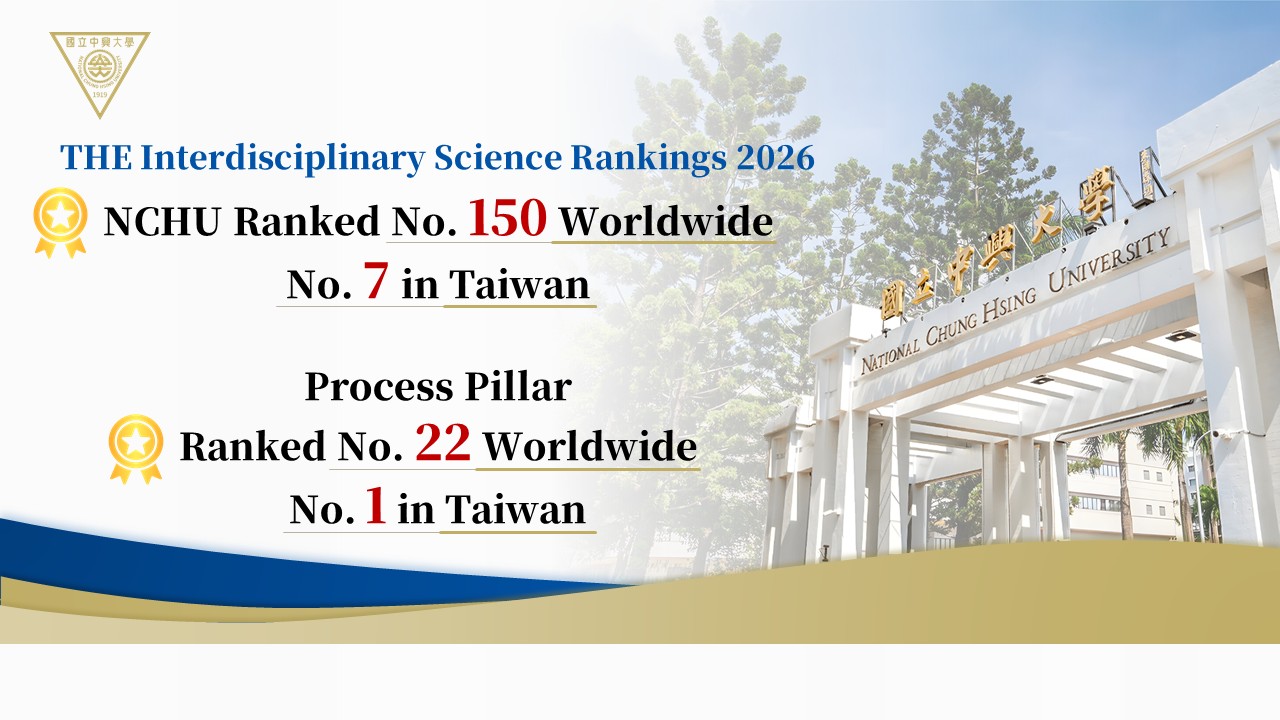
Times Higher Education (THE) announced the results of the 2026 Interdisciplinary Science Rankings (ISR) on November 20. In its debut participation, National Chung Hsing University (NCHU) achieved an impressive Global Rank of 150 and 7th in Taiwan, demonstrating outstanding interdisciplinary research strength. Notably, NCHU excelled in the Process pillar—representing institutional maturity, research governance, and support systems—ranking 22nd globally, within the top 2.4% worldwide, and No. 1 in Taiwan, underscoring its world-class capacity in interdisciplinary research governance and institutional design.
THE explains that the ISR evaluates universities across three major pillars—Inputs, Process, and Outputs—comprising 11 indicators that measure a university’s ability to integrate diverse research traditions, transcend disciplinary boundaries, and apply multi-disciplinary knowledge to global challenges. Interdisciplinary science spans not only integrated STEM fields such as Computer Science, Engineering, Life Sciences, and Physical Sciences, but also deep collaboration across Social Sciences, Education, Psychology, Law, Business & Economics, and Clinical & Health. NCHU’s debut performance within the Global Top 150 signals strong international competitiveness in interdisciplinary integration, research capacity, and institutional governance.
Strengthening Interdisciplinary Inputs: Multi-Core Research Clusters and National-Level Alliances
In recent years, NCHU has prioritized cross-domain collaboration as a key driver of institutional development. Through the Higher Education Sprout Project, the university has established a network of Featured Areas Research Centers, linking five strategic strengths:
Agri-Food Biotechnology, Intelligent Manufacturing, Healthcare, Green Energy & Carbon Reduction, and Advanced Computing—forming a multi-core ecosystem for interdisciplinary research.
NCHU also integrates university- and college-level research units to encourage cross-college collaboration, enabling faculty to participate in major interdisciplinary projects and global partnerships. Additionally, NCHU spearheaded the establishment of the National University System of Taiwan (NUST)—a consortium of 15 national universities, now the largest cross-institutional research and resource-sharing alliance in the country, accelerating interdisciplinary cooperation and research diffusion.
On the teaching front, NCHU has built a comprehensive interdisciplinary learning environment that includes cross-domain specializations, modular programs, micro-credit courses, an “Interdisciplinary Learning Marketplace,” and a self-check course planning system to support student pathways. Faculty benefit from cross-college teaching communities and AI-enabled instructional innovations, ensuring interdisciplinary curricula are fully embedded in teaching.
NCHU students consistently achieve top results in global competitions such as the Global Student Innovation Challenge (gSIC), the Cross-Strait Maker Competition, and the Green Idea Invention and Design Fair. The university’s STARTUP@NCHU Innovation Center—Taiwan’s first campus space where student teams can officially register company addresses—has already nurtured seven spin-off companies, illustrating a complete pipeline from cross-domain learning to innovation and entrepreneurship.
Nation’s No. 1 in Process: A Mature System for Research Governance, Facilities, and Administrative Support
The Process pillar—evaluating measures of success, physical facilities, administrative support, and tenure/promotion systems—is where NCHU ranked No. 1 nationwide, reflecting its exemplary institutionalization of interdisciplinary governance.
NCHU has developed a rigorous system for establishing and evaluating research units. University-level centers undergo formal evaluation every three years, with results determining their next operational cycle. College-level centers follow standardized approval mechanisms jointly overseen by the Office of Research and Development (ORD) and the Office of Academic Affairs, ensuring a campus-wide PDCA (Plan–Do–Check–Act) model for long-term, stable interdisciplinary collaboration.
The Instrument Center centralizes high-end research equipment and technical support to meet cross-college research needs. Administratively, ORD coordinates academic planning, project management, and resource allocation, supported by the university’s institutional research (IR) analytics to strengthen governance effectiveness. NCHU’s personnel policies also incorporate cross-college collaboration and interdisciplinary achievements into faculty evaluation and rewards, supported by flexible compensation, talent recruitment, and teaching-load adjustments—creating a solid institutional foundation for interdisciplinary research.
Excellence in Outputs: Research Quality, Global Impact, and Interdisciplinary Innovation
NCHU’s interdisciplinary research outputs have continued to rise across publication quality, citation impact, and applied innovation. The university ranks in the top 1% globally in 10 ESI fields, including:
Agricultural Sciences, Plant & Animal Science, Engineering, Chemistry, Biology & Biochemistry, Materials Science, Clinical Medicine, Pharmacology & Toxicology, Social Sciences (General), and Environment/Ecology.
NCHU leads Taiwan in interdisciplinary research areas such as AI-enabled smart agriculture, One Health, circular economy, intelligent manufacturing, and net-zero technologies. Its internationally influential research spans plant genomics, biotechnology, green materials and circular chemistry, agricultural sensing AI, smart production systems, and carbon sequestration methodologies. High-citation publications and international collaborations continue to grow, and NCHU faculty have been recognized with major national honors, including Academia Sinica Academicians, the NSTC Outstanding Research Award, the Ta-You Wu Memorial Award, the Future Tech Award, and the National Innovation Award.
NCHU’s innovations are also transforming industries and society. The university created Shennong TAIDE, the world’s first generative-AI model specialized for agriculture, trained on professional agri-data to provide real-time crop management advice, support government and corporate data-driven decisions, and enhance the effectiveness of agricultural robotics. NCHU also established Taiwan’s first Carbon-Neutral Demonstration Campus, integrating natural carbon sinks, energy management, and circular-economy technologies—positioning NCHU as a national leader in sustainability and net-zero innovation.
NCHU’s Commitment to Global Excellence
NCHU stated that ranking 150th globally and No. 1 nationwide in the Process pillar in its first participation in the THE Interdisciplinary Science Rankings affirms the university’s strong interdisciplinary governance, research support systems, and academic excellence. Looking ahead, NCHU will continue to advance its strategic vision of “Interdisciplinarity, Innovation, and Sustainability”—deepening cross-college collaboration, upgrading research infrastructure, strengthening global partnerships, and accelerating breakthroughs in areas such as agri-biotechnology, intelligent manufacturing, and sustainable energy.
With these efforts, NCHU is steadily advancing toward its goal of becoming a world-class comprehensive research university.
Times Higher Education (THE) announced the results of the 2026 Interdisciplinary Science Rankings (ISR) on November 20. In its debut participation, National Chung Hsing University (NCHU) achieved an impressive Global Rank of 150 and 7th in Taiwan, demonstrating outstanding interdisciplinary research strength. Notably, NCHU excelled in the Process pillar—representing institutional maturity, research governance, and support systems—ranking 22nd globally, within the top 2.4% worldwide, and No. 1 in Taiwan, underscoring its world-class capacity in interdisciplinary research governance and institutional design.
THE explains that the ISR evaluates universities across three major pillars—Inputs, Process, and Outputs—comprising 11 indicators that measure a university’s ability to integrate diverse research traditions, transcend disciplinary boundaries, and apply multi-disciplinary knowledge to global challenges. Interdisciplinary science spans not only integrated STEM fields such as Computer Science, Engineering, Life Sciences, and Physical Sciences, but also deep collaboration across Social Sciences, Education, Psychology, Law, Business & Economics, and Clinical & Health. NCHU’s debut performance within the Global Top 150 signals strong international competitiveness in interdisciplinary integration, research capacity, and institutional governance.
Strengthening Interdisciplinary Inputs: Multi-Core Research Clusters and National-Level Alliances
In recent years, NCHU has prioritized cross-domain collaboration as a key driver of institutional development. Through the Higher Education Sprout Project, the university has established a network of Featured Areas Research Centers, linking five strategic strengths:
Agri-Food Biotechnology, Intelligent Manufacturing, Healthcare, Green Energy & Carbon Reduction, and Advanced Computing—forming a multi-core ecosystem for interdisciplinary research.
NCHU also integrates university- and college-level research units to encourage cross-college collaboration, enabling faculty to participate in major interdisciplinary projects and global partnerships. Additionally, NCHU spearheaded the establishment of the National University System of Taiwan (NUST)—a consortium of 15 national universities, now the largest cross-institutional research and resource-sharing alliance in the country, accelerating interdisciplinary cooperation and research diffusion.
On the teaching front, NCHU has built a comprehensive interdisciplinary learning environment that includes cross-domain specializations, modular programs, micro-credit courses, an “Interdisciplinary Learning Marketplace,” and a self-check course planning system to support student pathways. Faculty benefit from cross-college teaching communities and AI-enabled instructional innovations, ensuring interdisciplinary curricula are fully embedded in teaching.
NCHU students consistently achieve top results in global competitions such as the Global Student Innovation Challenge (gSIC), the Cross-Strait Maker Competition, and the Green Idea Invention and Design Fair. The university’s STARTUP@NCHU Innovation Center—Taiwan’s first campus space where student teams can officially register company addresses—has already nurtured seven spin-off companies, illustrating a complete pipeline from cross-domain learning to innovation and entrepreneurship.
Nation’s No. 1 in Process: A Mature System for Research Governance, Facilities, and Administrative Support
The Process pillar—evaluating measures of success, physical facilities, administrative support, and tenure/promotion systems—is where NCHU ranked No. 1 nationwide, reflecting its exemplary institutionalization of interdisciplinary governance.
NCHU has developed a rigorous system for establishing and evaluating research units. University-level centers undergo formal evaluation every three years, with results determining their next operational cycle. College-level centers follow standardized approval mechanisms jointly overseen by the Office of Research and Development (ORD) and the Office of Academic Affairs, ensuring a campus-wide PDCA (Plan–Do–Check–Act) model for long-term, stable interdisciplinary collaboration.
The Instrument Center centralizes high-end research equipment and technical support to meet cross-college research needs. Administratively, ORD coordinates academic planning, project management, and resource allocation, supported by the university’s institutional research (IR) analytics to strengthen governance effectiveness. NCHU’s personnel policies also incorporate cross-college collaboration and interdisciplinary achievements into faculty evaluation and rewards, supported by flexible compensation, talent recruitment, and teaching-load adjustments—creating a solid institutional foundation for interdisciplinary research.
Excellence in Outputs: Research Quality, Global Impact, and Interdisciplinary Innovation
NCHU’s interdisciplinary research outputs have continued to rise across publication quality, citation impact, and applied innovation. The university ranks in the top 1% globally in 10 ESI fields, including:
Agricultural Sciences, Plant & Animal Science, Engineering, Chemistry, Biology & Biochemistry, Materials Science, Clinical Medicine, Pharmacology & Toxicology, Social Sciences (General), and Environment/Ecology.
NCHU leads Taiwan in interdisciplinary research areas such as AI-enabled smart agriculture, One Health, circular economy, intelligent manufacturing, and net-zero technologies. Its internationally influential research spans plant genomics, biotechnology, green materials and circular chemistry, agricultural sensing AI, smart production systems, and carbon sequestration methodologies. High-citation publications and international collaborations continue to grow, and NCHU faculty have been recognized with major national honors, including Academia Sinica Academicians, the NSTC Outstanding Research Award, the Ta-You Wu Memorial Award, the Future Tech Award, and the National Innovation Award.
NCHU’s innovations are also transforming industries and society. The university created Shennong TAIDE, the world’s first generative-AI model specialized for agriculture, trained on professional agri-data to provide real-time crop management advice, support government and corporate data-driven decisions, and enhance the effectiveness of agricultural robotics. NCHU also established Taiwan’s first Carbon-Neutral Demonstration Campus, integrating natural carbon sinks, energy management, and circular-economy technologies—positioning NCHU as a national leader in sustainability and net-zero innovation.
NCHU’s Commitment to Global Excellence
NCHU stated that ranking 150th globally and No. 1 nationwide in the Process pillar in its first participation in the THE Interdisciplinary Science Rankings affirms the university’s strong interdisciplinary governance, research support systems, and academic excellence. Looking ahead, NCHU will continue to advance its strategic vision of “Interdisciplinarity, Innovation, and Sustainability”—deepening cross-college collaboration, upgrading research infrastructure, strengthening global partnerships, and accelerating breakthroughs in areas such as agri-biotechnology, intelligent manufacturing, and sustainable energy.
With these efforts, NCHU is steadily advancing toward its goal of becoming a world-class comprehensive research university.