


NCHU’s Coffee Beans from the Huisun Experimental Forest Station Become the World’s Only Coffee Product to Achieve Full FSC Chain-of-Custody Certification
2026-01-07
興新聞張貼者
Unit秘書室
1,748
The Experimental Forest Management Office of National Chung Hsing University (NCHU) oversees four university-managed forest stations, including the Huisun Experimental Forest Station, Hsinhua, Tungshih, and Wenshan Experimental Forest Station. With education, research, and experimentation as its core missions, the office has long upheld the principles of sustainable forest management—balancing ecological conservation with the responsible and rational use of forest resources, while actively fulfilling the university’s social responsibility (USR).
To ensure that forest governance and related product utilization comply with international sustainability standards, the office has introduced the Forest Stewardship Council (FSC) certification system, strengthening professionalism, transparency, raw material control, and product traceability across the entire supply chain.
After an audit conducted by a third-party certification institute in 2024, the management of NCHU’s forests were verified to comply with FSC Forest Management (FM) standards. And the FSC FM certification demonstrated that NCHU has established a sustainable forest management system that matched global best-practice benchmarks. In addition to continual improvements the quality of forest management, the office has also followed FSC principles to progressively refine mechanisms for utilization of forest resource, management of raw material, and public information disclosure—laying a consistent and comprehensive institutional foundation for the development and promotion of certified sustainable products.
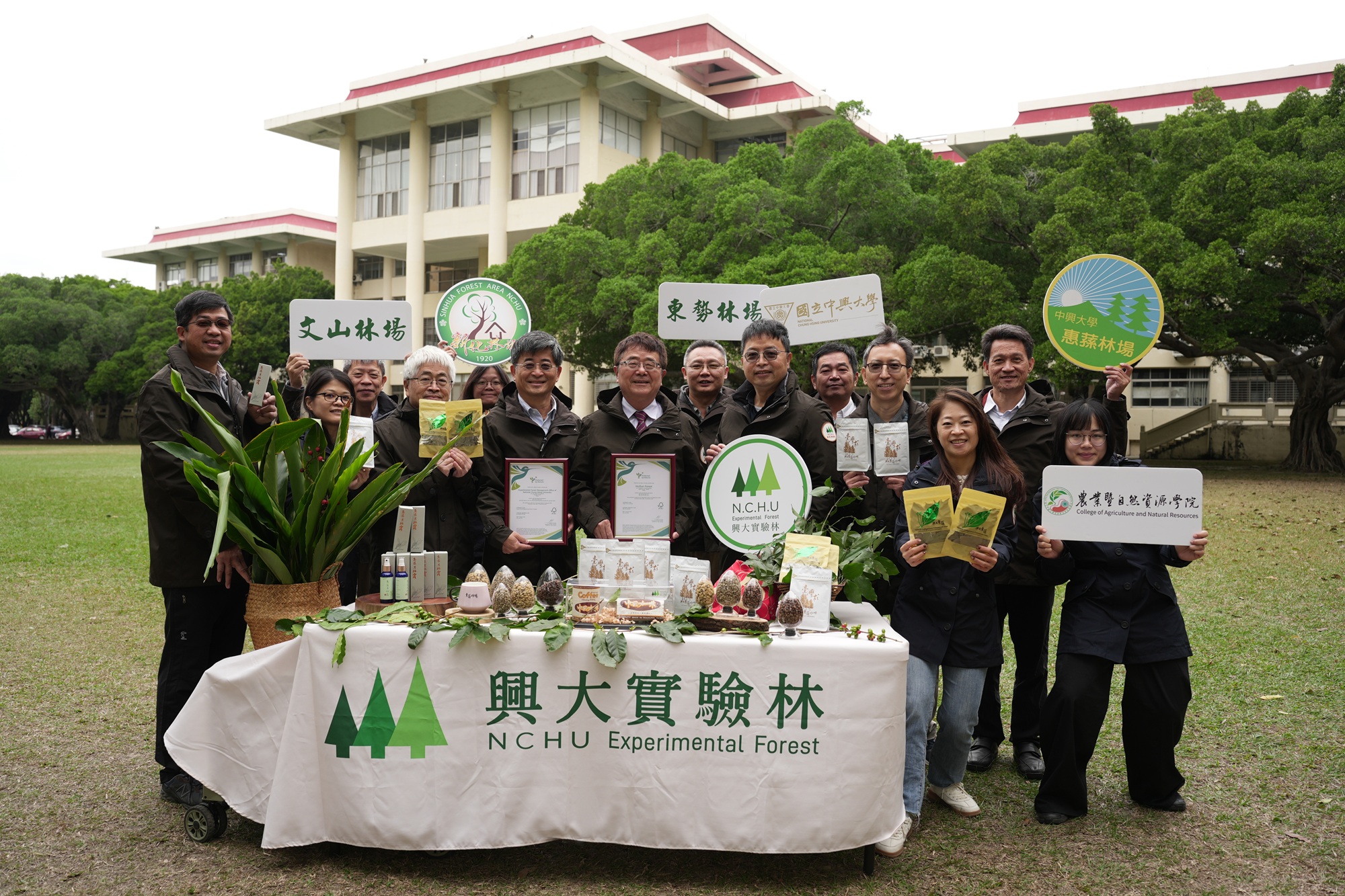
To further enhance the traceability of products from origin to markets, the office has also completed FSC Chain of Custody (CoC) certification for factories involved in final-stage processing. Certified products include coffee beans, hydrosol from Alpinia zerumbet, essential oil from Cunninghamia konishii Hayata, and leaves of Cinnamomum osmophloeum Kanehira.
Among these, coffee beans produced by the Huisun Experimental Forest Station currently stand as the only one which passed both FSC FM/CoC and CoC certification in the world. Including cultivation and tending for coffee tree, fruit harvesting, processing, manufacturing, product labeling, and certification mark authorization, every stage complies with FSC standards —highlighting NCHU’s collective achievements in sustainable forest management and responsible production.
The FSC CoC certification system is designed to ensure that forest products are supported by an auditable and verified tracking mechanism from origin to final consumption. This milestone not only strengthens NCHU’s forest and product management, but also enhances the public value of sustainability education, academic demonstration, and institutional communication.
Looking ahead, NCHU’s Experimental Forest Management Office will continue to advance sustainable forest stewardship and cross-sector collaboration, deepen engagement with local communities, and partner with industry and civic sectors to jointly promote ecological conservation, responsible consumption, and long-term environmental sustainability.

To ensure that forest governance and related product utilization comply with international sustainability standards, the office has introduced the Forest Stewardship Council (FSC) certification system, strengthening professionalism, transparency, raw material control, and product traceability across the entire supply chain.
After an audit conducted by a third-party certification institute in 2024, the management of NCHU’s forests were verified to comply with FSC Forest Management (FM) standards. And the FSC FM certification demonstrated that NCHU has established a sustainable forest management system that matched global best-practice benchmarks. In addition to continual improvements the quality of forest management, the office has also followed FSC principles to progressively refine mechanisms for utilization of forest resource, management of raw material, and public information disclosure—laying a consistent and comprehensive institutional foundation for the development and promotion of certified sustainable products.
To further enhance the traceability of products from origin to markets, the office has also completed FSC Chain of Custody (CoC) certification for factories involved in final-stage processing. Certified products include coffee beans, hydrosol from Alpinia zerumbet, essential oil from Cunninghamia konishii Hayata, and leaves of Cinnamomum osmophloeum Kanehira.
Among these, coffee beans produced by the Huisun Experimental Forest Station currently stand as the only one which passed both FSC FM/CoC and CoC certification in the world. Including cultivation and tending for coffee tree, fruit harvesting, processing, manufacturing, product labeling, and certification mark authorization, every stage complies with FSC standards —highlighting NCHU’s collective achievements in sustainable forest management and responsible production.
The FSC CoC certification system is designed to ensure that forest products are supported by an auditable and verified tracking mechanism from origin to final consumption. This milestone not only strengthens NCHU’s forest and product management, but also enhances the public value of sustainability education, academic demonstration, and institutional communication.
Looking ahead, NCHU’s Experimental Forest Management Office will continue to advance sustainable forest stewardship and cross-sector collaboration, deepen engagement with local communities, and partner with industry and civic sectors to jointly promote ecological conservation, responsible consumption, and long-term environmental sustainability.
NCHU’s Coffee Beans from the Huisun Experimental Forest Station Become the World’s Only Coffee Product to Achieve Full FSC Chain-of-Custody Certification