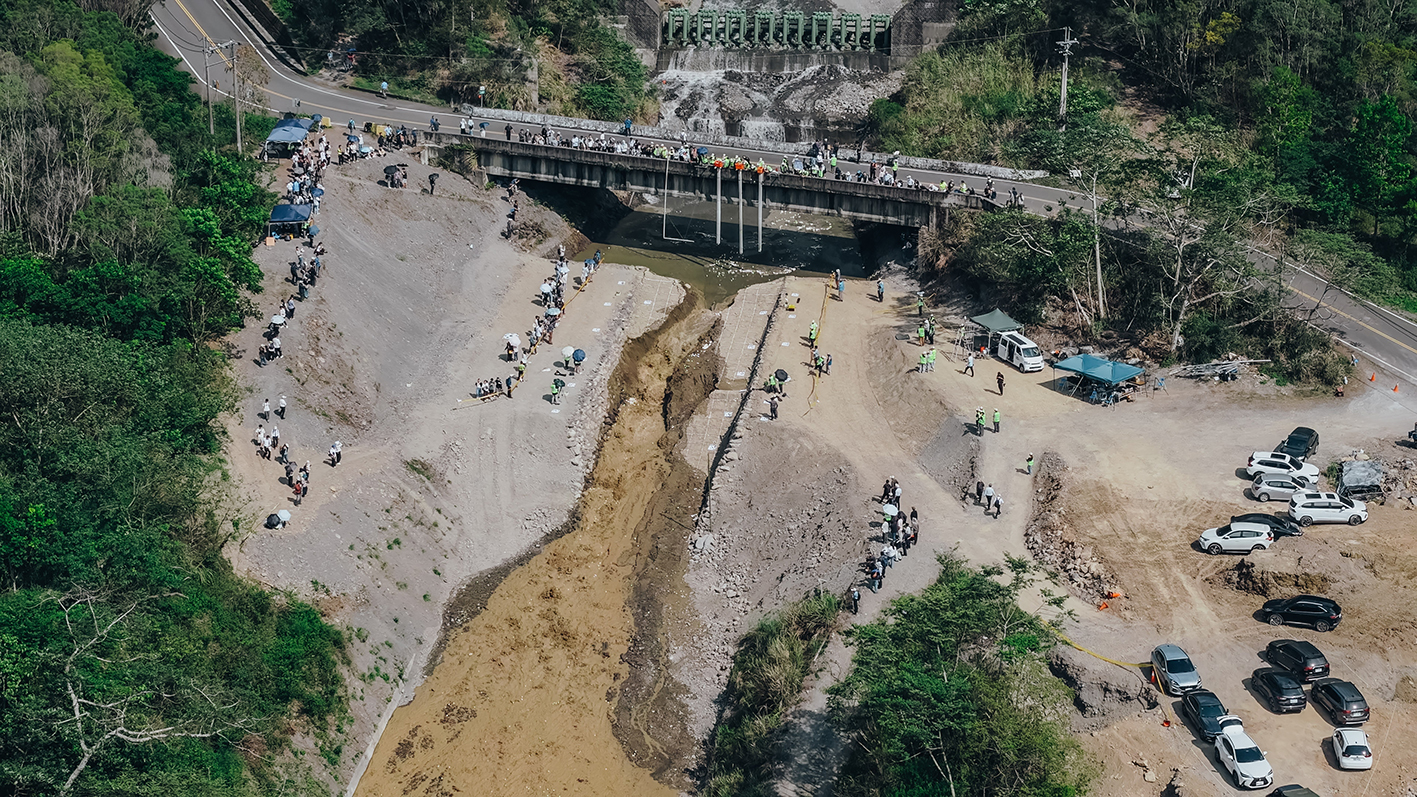


Unveiling the Mechanisms of Taiwan’s Largest Landslide Dam Breach: NCHU Conducts 1/50 Scale Model Experiment of Matai’an River Event at Huisun Forest
2026-04-29
興新聞張貼者
Unit秘書室
2,204
Release Date: April 20, 2026
Location: Huisun Forest, National Chung Hsing University, Nantou County, Taiwan
In recent years, the intensification of extreme climate events has led to increasingly frequent compound disasters in Taiwan’s mountainous regions. Among these, the formation and subsequent breach of landslide dams pose a severe threat to downstream communities. To gain a deeper understanding of these disaster mechanisms, a research team led by Distinguished Professor Su-Chin Chen of National Chung Hsing University (NCHU) has conducted a large-scale experimental site at Landao Creek in the Huisun Forest.
Developed progressively since 2010, the facility integrates the Nenggao Canal's discharge control system, enabling precise regulation of flood flows. Combined with advanced topographic surveying, synchronous videography, and water-level monitoring, it has become one of the few experimental fields globally capable of simulating large-scale landslide-dam breach processes. Over the years, the facility has continuously refined its experimental methods and observation systems. In 2023, it hosted an international disaster prevention symposium, presenting research outcomes to experts from 16 countries and receiving high recognition from the global disaster mitigation academia.
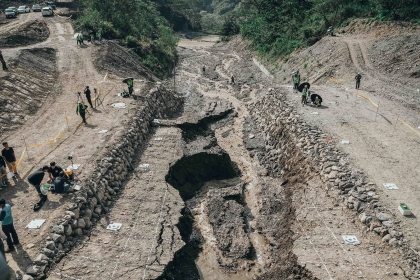
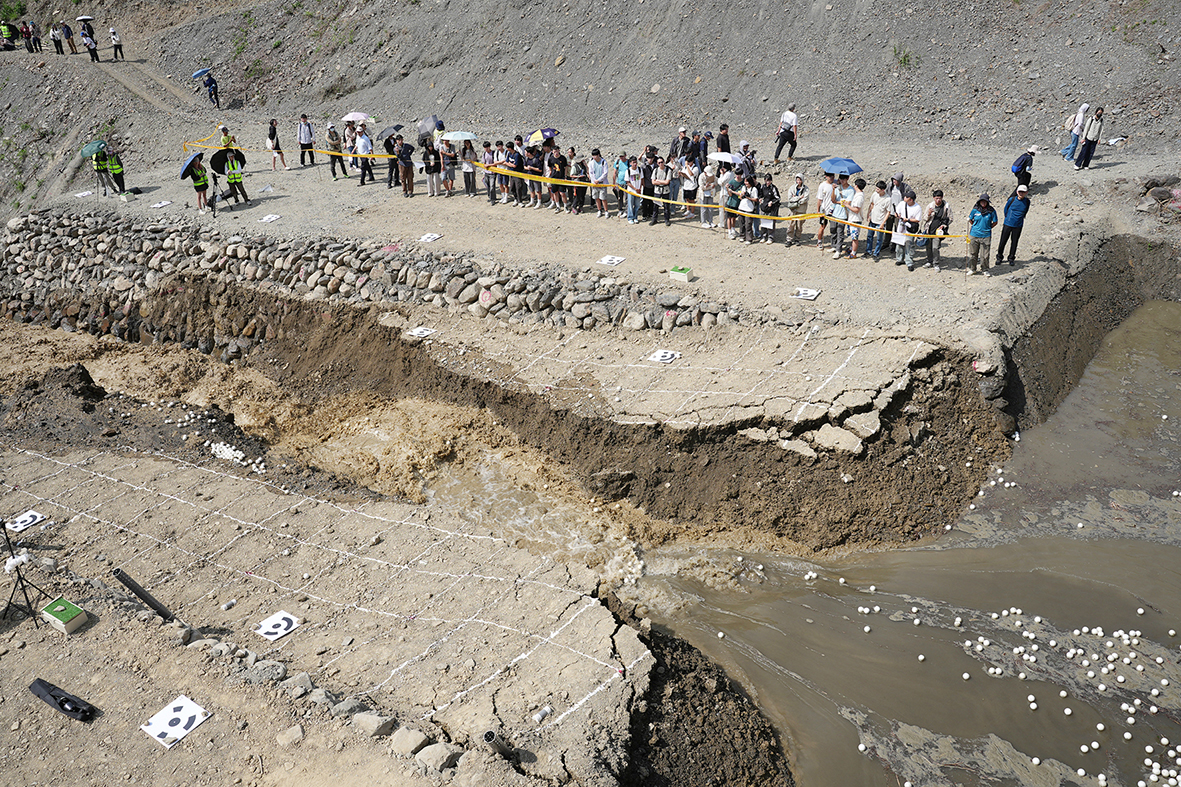
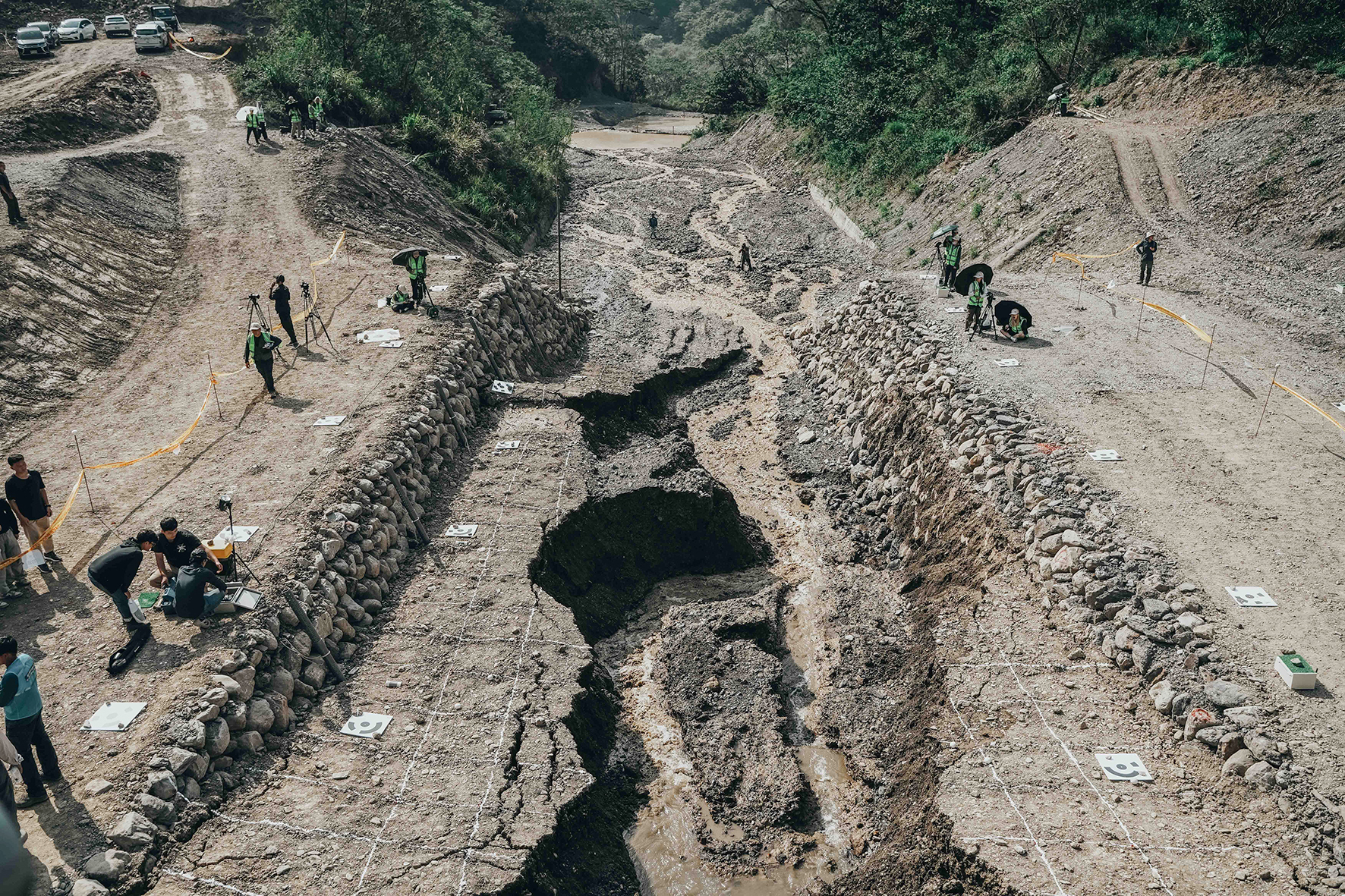
In response to the 2025 Matai’an River Landslide Dam event in Hualien, the Forestry and Nature Conservation Agency (MOA) commissioned Professor Chen’s team at NCHU, in collaboration with experts from National Yang Ming Chiao Tung University and National Cheng Kung University, to conduct a 1/50 physical scale model experiment on April 20, 2026. The experiment aims to reconstruct the entire lifecycle of the landslide dam, from formation to its eventual breach. The Matai’an River dam was the largest in Taiwan’s recorded history, standing approximately 200 meters high with a volume of nearly 200 million cubic meters. Due to the remote mountainous location, observational data during the initial breach phase were limited. This physical model experiment provides critical scientific insights by reconstructing the breach dynamics under controlled conditions.
The experiment employs a "4D Spatiotemporal Synchronous Observation Framework" that integrates multiple high-precision measurement technologies. Key parameters monitored include water level and flow velocity, dam collapse and breach expansion, sediment transport, upstream and downstream topographic evolution, underwater scouring processes, internal pore-water pressure, and seismic signals. These multi-scale, multi-parameter observations enable a comprehensive analysis of the hydraulic and geomorphic mechanisms governing landslide dam failure and provide a robust foundation for future early warning systems and disaster prevention strategies.
The experiment was conducted in partnership with the Rural Development and Soil and Water Conservation Agency (MOA). It invited domestic and international experts (including Japanese Sabo specialists), professional engineers, and the general public to observe the simulation. Through on-site demonstrations and academic exchange, the event aimed to heighten awareness of landslide dams and their derivative hazards while strengthening disaster education and risk communication. The findings are expected to support the prediction of breach timing and peak discharge, inform evacuation planning, and guide watershed-scale disaster management decisions, thereby reducing uncertainty and improving emergency response efficiency.
The simulation mobilized over 60 personnel and utilized multiple units of heavy machinery, following months of meticulous planning and construction. It stands as one of the largest landslide dam simulation experiments ever conducted. Distinguished Professor Chen noted a significant academic breakthrough but also a critical step toward enhancing national disaster resilience and safeguarding the lives and property of downstream residents. Through scientific experimentation and interdisciplinary collaboration, Taiwan continues to strengthen its overall resilience against extreme climate and sediment-related disasters.
The Matai’an River scale model experiment marks a major milestone in Taiwan’s research on large-scale sediment-related hazards and disaster prevention technologies. Moving forward, the research team will continue to refine these results and collaborate with government agencies and stakeholders to develop more accurate, effective, and resilient disaster management systems. Moving forward, the research team will continue to refine its findings and collaborate with government agencies and stakeholders to develop more accurate, effective, and resilient disaster management systems.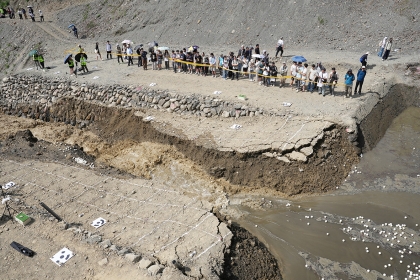
Location: Huisun Forest, National Chung Hsing University, Nantou County, Taiwan
In recent years, the intensification of extreme climate events has led to increasingly frequent compound disasters in Taiwan’s mountainous regions. Among these, the formation and subsequent breach of landslide dams pose a severe threat to downstream communities. To gain a deeper understanding of these disaster mechanisms, a research team led by Distinguished Professor Su-Chin Chen of National Chung Hsing University (NCHU) has conducted a large-scale experimental site at Landao Creek in the Huisun Forest.
Developed progressively since 2010, the facility integrates the Nenggao Canal's discharge control system, enabling precise regulation of flood flows. Combined with advanced topographic surveying, synchronous videography, and water-level monitoring, it has become one of the few experimental fields globally capable of simulating large-scale landslide-dam breach processes. Over the years, the facility has continuously refined its experimental methods and observation systems. In 2023, it hosted an international disaster prevention symposium, presenting research outcomes to experts from 16 countries and receiving high recognition from the global disaster mitigation academia.
In response to the 2025 Matai’an River Landslide Dam event in Hualien, the Forestry and Nature Conservation Agency (MOA) commissioned Professor Chen’s team at NCHU, in collaboration with experts from National Yang Ming Chiao Tung University and National Cheng Kung University, to conduct a 1/50 physical scale model experiment on April 20, 2026. The experiment aims to reconstruct the entire lifecycle of the landslide dam, from formation to its eventual breach. The Matai’an River dam was the largest in Taiwan’s recorded history, standing approximately 200 meters high with a volume of nearly 200 million cubic meters. Due to the remote mountainous location, observational data during the initial breach phase were limited. This physical model experiment provides critical scientific insights by reconstructing the breach dynamics under controlled conditions.
The experiment employs a "4D Spatiotemporal Synchronous Observation Framework" that integrates multiple high-precision measurement technologies. Key parameters monitored include water level and flow velocity, dam collapse and breach expansion, sediment transport, upstream and downstream topographic evolution, underwater scouring processes, internal pore-water pressure, and seismic signals. These multi-scale, multi-parameter observations enable a comprehensive analysis of the hydraulic and geomorphic mechanisms governing landslide dam failure and provide a robust foundation for future early warning systems and disaster prevention strategies.
The experiment was conducted in partnership with the Rural Development and Soil and Water Conservation Agency (MOA). It invited domestic and international experts (including Japanese Sabo specialists), professional engineers, and the general public to observe the simulation. Through on-site demonstrations and academic exchange, the event aimed to heighten awareness of landslide dams and their derivative hazards while strengthening disaster education and risk communication. The findings are expected to support the prediction of breach timing and peak discharge, inform evacuation planning, and guide watershed-scale disaster management decisions, thereby reducing uncertainty and improving emergency response efficiency.
The simulation mobilized over 60 personnel and utilized multiple units of heavy machinery, following months of meticulous planning and construction. It stands as one of the largest landslide dam simulation experiments ever conducted. Distinguished Professor Chen noted a significant academic breakthrough but also a critical step toward enhancing national disaster resilience and safeguarding the lives and property of downstream residents. Through scientific experimentation and interdisciplinary collaboration, Taiwan continues to strengthen its overall resilience against extreme climate and sediment-related disasters.
The Matai’an River scale model experiment marks a major milestone in Taiwan’s research on large-scale sediment-related hazards and disaster prevention technologies. Moving forward, the research team will continue to refine these results and collaborate with government agencies and stakeholders to develop more accurate, effective, and resilient disaster management systems. Moving forward, the research team will continue to refine its findings and collaborate with government agencies and stakeholders to develop more accurate, effective, and resilient disaster management systems.
Unveiling the Mechanisms of Taiwan’s Largest Landslide Dam Breach: NCHU Conducts 1/50 Scale Model Experiment of Matai’an River Event at Huisun Forest
Unveiling the Mechanisms of Taiwan’s Largest Landslide Dam Breach: NCHU Conducts 1/50 Scale Model Experiment of Matai’an River Event at Huisun Forest