


First Indo-West Pacific Fiddler Crab Ethogram Published NCHU Researchers Provide Comprehensive Analysis of the Behavioral System of the Endemic Taiwanese Fiddler Crab
2026-04-29
興新聞張貼者
Unit秘書室
1,609
A new breakthrough has been made in the study of Taiwan’s endemic fiddler crabs. A research team from the Department of Life Sciences at National Chung Hsing University (NCHU) has completed the most comprehensive behavioral documentation and analysis to date of the Taiwanese fiddler crab (Xeruca formosensis), a representative crustacean inhabiting Taiwan’s coastal mudflats. The study systematically describes its daily activities, social interactions, agonistic behaviors, and reproductive behaviors, and establishes the first ethogram (behavioral repertoire) for a fiddler crab in the Indo-West Pacific region. The results were published in April in the international crustacean journal Nauplius, marking an important milestone for related research in Taiwan.
The research team, led by Ph.D. student Kai Chang and Professor Hsi-Te Shih, identified a total of 20 behavioral patterns in X. formosensis, which were categorized into three major functional groups: non-social, agonistic, and reproductive behaviors. In addition to classifying these behaviors, the study further analyzed the sequential relationships among different actions, allowing researchers to better understand how this species feeds, interacts, competes, courts, and reproduces.
The study also revealed that the seemingly uniform claw-waving behavior of X. formosensis actually serves multiple functions, including territorial display, agonistic interaction, and courtship signaling. Although these movements appear similar, they convey distinct social signals, reflecting the species’ complex and nuanced behavioral communication system.
Beyond claw-waving, the study highlights several distinctive behaviors unique to this species, including males constructing chimney-like structures at burrow entrances, females building pyramid-shaped structures, as well as surface interactions, female-guiding behavior, pairing, and mating. These findings not only underscore the uniqueness of X. formosensis as an endemic species of Taiwan, but also establish it as an important model for studying behavior, ecology, and evolution.
Another key contribution of this study lies in the establishment of a complete ethogram, which has significant implications for conservation. Conservation efforts should not only determine whether a species persists, but also whether individuals can still perform a full and normal range of behaviors. Previous studies have shown that under human disturbance, crabs may exhibit reduced behavioral repertoires or abnormal behaviors. Therefore, this ethogram serves not only as a fundamental scientific reference, but also as an important baseline for assessing habitat quality, disturbance impacts, and population health. Even if a population persists, noticeable reductions or abnormalities in key social and reproductive behaviors—such as claw-waving, courtship, mating, chimney building, or pyramid construction—may indicate that habitat conditions are impairing normal biological functions.
Professor Hsi-Te Shih, who has studied fiddler crabs worldwide for over 30 years, emphasized that this comprehensive behavioral dataset will make substantial contributions to understanding the behavioral mechanisms, ecological adaptations, evolutionary context, and conservation needs of X. formosensis. The establishment of a complete ethogram also enables conservation assessments to move beyond simply asking whether the species still exists, toward evaluating whether it continues to maintain normal and complete behavioral patterns, which is crucial for future monitoring and management.
Research Highlights
1. Endemic species and endemic genus: Xeruca formosensis is found only in Taiwan and is a representative species of local mudflat coastal ecosystems.
2. First complete ethogram established: A total of 20 behaviors were identified, covering non-social, agonistic, and reproductive categories.
3. First complete ethogram of an Indo-West Pacific fiddler crab: Published in the 2026 international crustacean journal Nauplius.
4. Functional differentiation in claw-waving: Different types of waving are associated with territorial display and courtship signaling.
5. Baseline for conservation monitoring: Provides a tool to assess whether habitat disturbance affects normal behavior and reproductive function.
https://www.researchgate.net/publication/403987089_An_ethogram_of_the_fiddler_crab_Xeruca_formosensis_Rathbun_1921_Brachyura_Ocypodidae_with_emphasis_on_its_social_behaviors

The research team, led by Ph.D. student Kai Chang and Professor Hsi-Te Shih, identified a total of 20 behavioral patterns in X. formosensis, which were categorized into three major functional groups: non-social, agonistic, and reproductive behaviors. In addition to classifying these behaviors, the study further analyzed the sequential relationships among different actions, allowing researchers to better understand how this species feeds, interacts, competes, courts, and reproduces.
The study also revealed that the seemingly uniform claw-waving behavior of X. formosensis actually serves multiple functions, including territorial display, agonistic interaction, and courtship signaling. Although these movements appear similar, they convey distinct social signals, reflecting the species’ complex and nuanced behavioral communication system.
Beyond claw-waving, the study highlights several distinctive behaviors unique to this species, including males constructing chimney-like structures at burrow entrances, females building pyramid-shaped structures, as well as surface interactions, female-guiding behavior, pairing, and mating. These findings not only underscore the uniqueness of X. formosensis as an endemic species of Taiwan, but also establish it as an important model for studying behavior, ecology, and evolution.
Another key contribution of this study lies in the establishment of a complete ethogram, which has significant implications for conservation. Conservation efforts should not only determine whether a species persists, but also whether individuals can still perform a full and normal range of behaviors. Previous studies have shown that under human disturbance, crabs may exhibit reduced behavioral repertoires or abnormal behaviors. Therefore, this ethogram serves not only as a fundamental scientific reference, but also as an important baseline for assessing habitat quality, disturbance impacts, and population health. Even if a population persists, noticeable reductions or abnormalities in key social and reproductive behaviors—such as claw-waving, courtship, mating, chimney building, or pyramid construction—may indicate that habitat conditions are impairing normal biological functions.
Professor Hsi-Te Shih, who has studied fiddler crabs worldwide for over 30 years, emphasized that this comprehensive behavioral dataset will make substantial contributions to understanding the behavioral mechanisms, ecological adaptations, evolutionary context, and conservation needs of X. formosensis. The establishment of a complete ethogram also enables conservation assessments to move beyond simply asking whether the species still exists, toward evaluating whether it continues to maintain normal and complete behavioral patterns, which is crucial for future monitoring and management.
Research Highlights
1. Endemic species and endemic genus: Xeruca formosensis is found only in Taiwan and is a representative species of local mudflat coastal ecosystems.
2. First complete ethogram established: A total of 20 behaviors were identified, covering non-social, agonistic, and reproductive categories.
3. First complete ethogram of an Indo-West Pacific fiddler crab: Published in the 2026 international crustacean journal Nauplius.
4. Functional differentiation in claw-waving: Different types of waving are associated with territorial display and courtship signaling.
5. Baseline for conservation monitoring: Provides a tool to assess whether habitat disturbance affects normal behavior and reproductive function.
https://www.researchgate.net/publication/403987089_An_ethogram_of_the_fiddler_crab_Xeruca_formosensis_Rathbun_1921_Brachyura_Ocypodidae_with_emphasis_on_its_social_behaviors
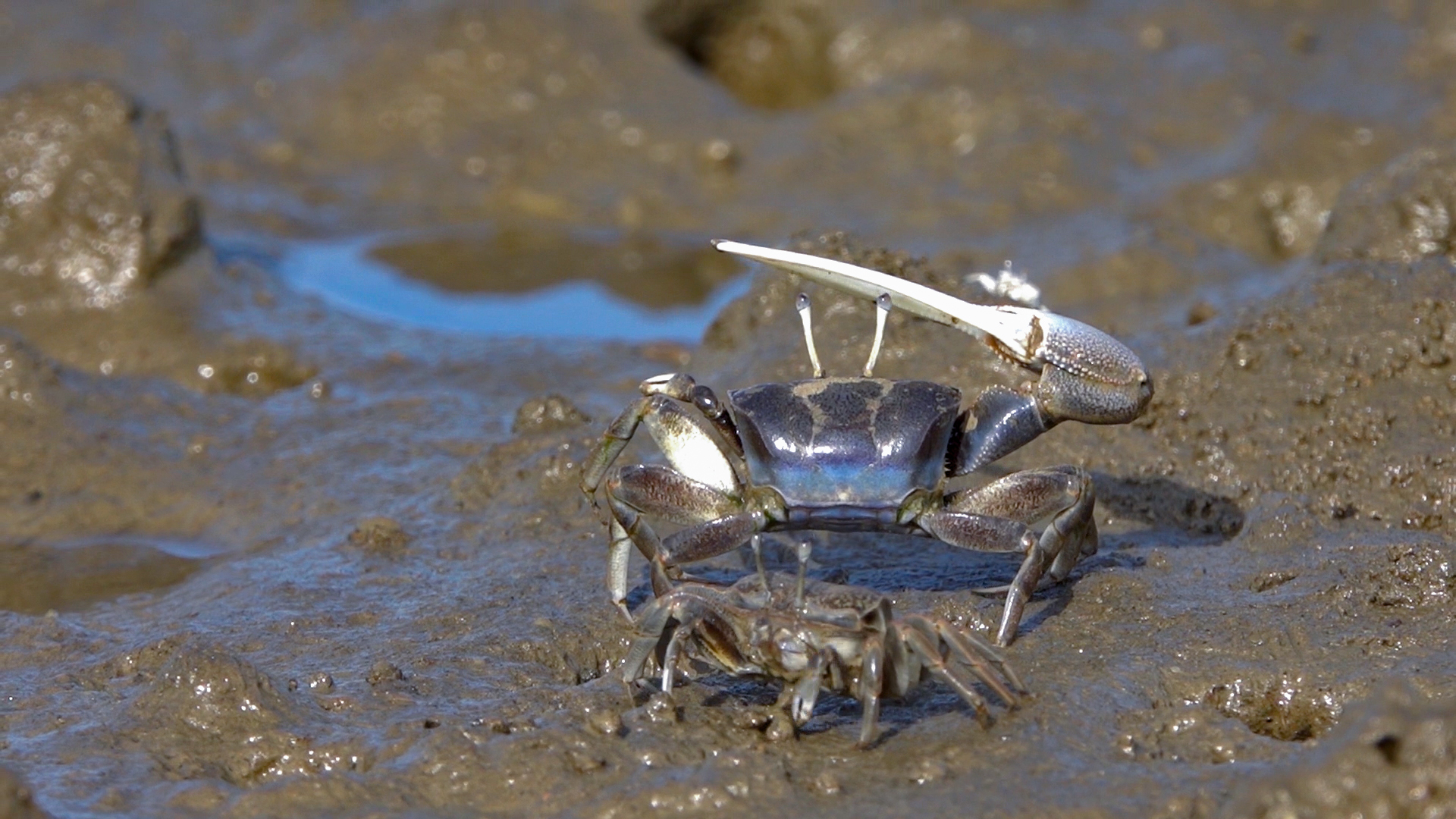
Agonistic aggregation and courtship claw-waving behavior in the Taiwanese fiddler crab. Photo credit: Invertebrate Laboratory, NCHU
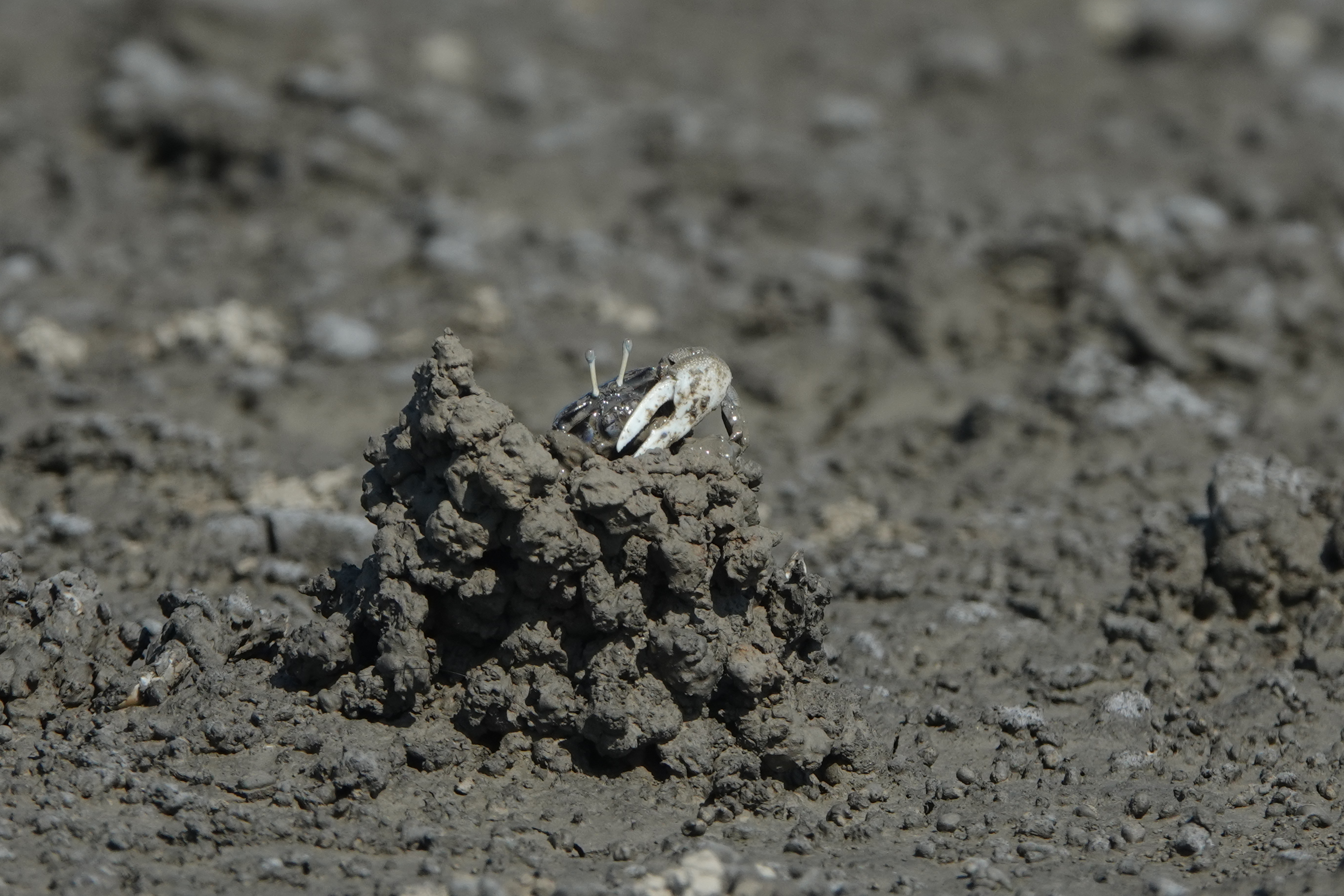
Male fiddler crab constructing a chimney-like structure at the burrow entrance. Photo credit: Invertebrate Laboratory, NCHU