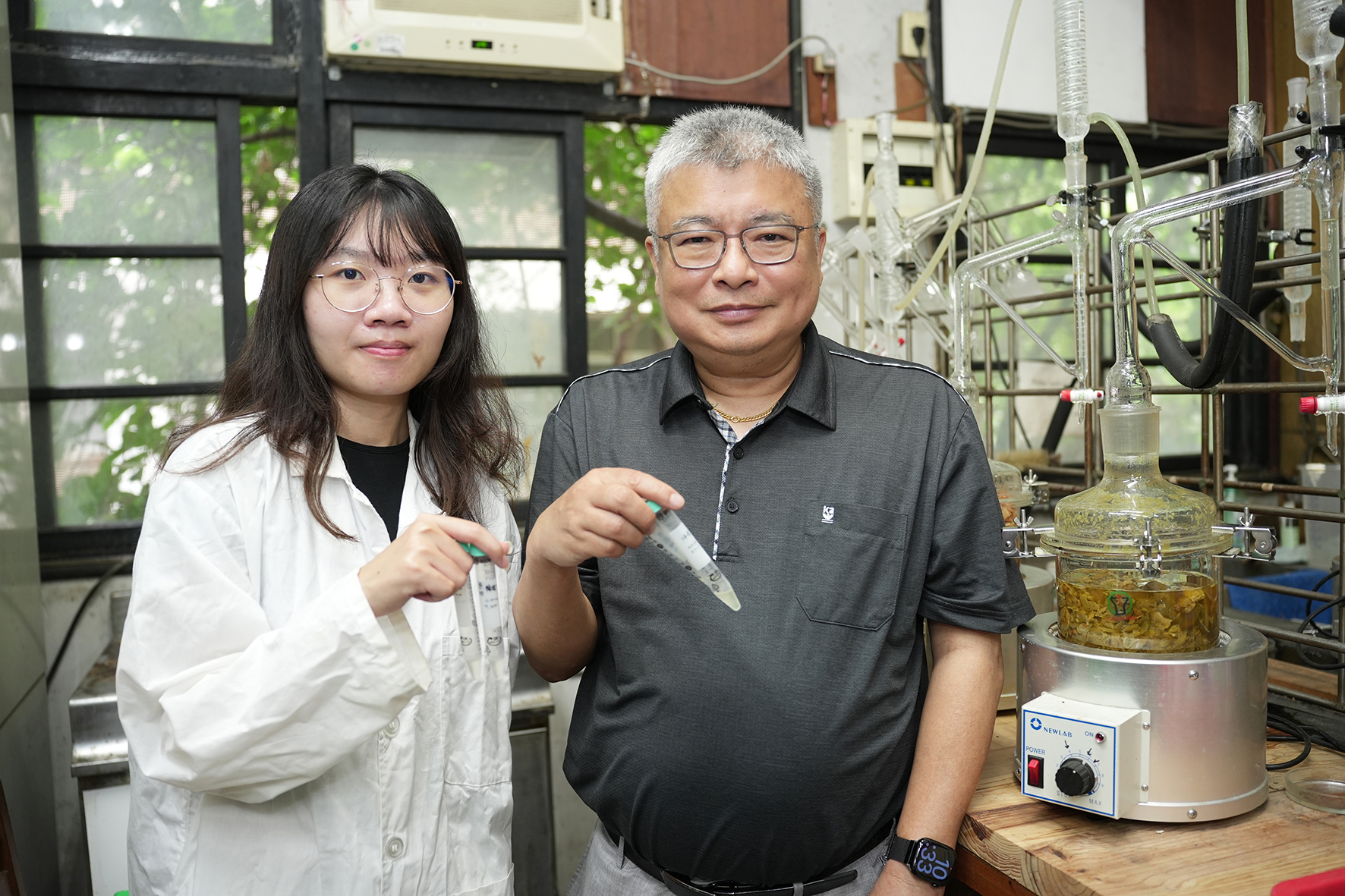


Citrus Waste Turned into Gold: NCHU Study Reveals Essential Oil Compound Enhances Mitochondrial Energy and Protects Neuronal Cells
2026-05-07
興新聞張貼者
Unit秘書室
1,575
A research team from the Academy of Circular Economy at National Chung Hsing University has discovered that citrus-processing waste, particularly peels and pomace, contains high levels of the natural monoterpene compound γ-terpinene, which can significantly enhance mitochondrial bioenergetics and protect neuronal cells from damage.
The study provides new scientific evidence supporting the high-value utilization of agricultural waste resources and was recently published in the international journal Journal of Functional Foods (2026).
The research was led by Dean Sheng-Yang Wang from the Academy of Circular Economy, with contributions from Dr. Mo-Rong Xu and Ms. Ching-Yi Tsai. The team systematically elucidated, for the first time, the neuroprotective mechanisms of citrus essential oil compounds from the perspective of mitochondrial bioenergetics, opening new directions for natural product applications.
From Agricultural Waste to Functional Biomaterials: Advancing the Circular Economy
Dean Sheng-Yang Wang pointed out that nearly 50% of citrus fruits become waste during juice processing and industrial production, with peels accounting for the majority. These residues not only create environmental burdens but also increase disposal costs.
Through essential oil extraction and bioactivity evaluation, the research team successfully transformed low-value citrus waste into biologically active functional compounds with biomedical potential, demonstrating the core concept of the circular economy: “Transforming low-value waste into high-value bioactive materials.”This study highlights how agricultural by-products can be upgraded into sustainable health-promoting resources rather than simply discarded.
Key Mechanism: Activating Mitochondria, Increasing ATP, and Protecting Neurons
Dr. Mo-Rong Xu explained that mitochondria function as the “power plants” of cells, generating ATP, the essential energy currency required for cellular activities. When mitochondrial function is impaired, ATP production declines, leading to cellular energy deficiency. Neuronal cells are particularly vulnerable because of their exceptionally high energy demand.
Using a glutamate-induced neuronal injury model, the researchers demonstrated that γ-terpinene exerts multiple protective effects, including:
• Restoring mitochondrial membrane potential
• Enhancing ATP production
• Reducing oxidative stress and cellular damage
• Lowering ROS, MDA, and LDH levels
• Promoting dopamine and norepinephrine synthesis
Overall, γ-terpinene helped repair cellular energy metabolism and protected neuronal cells from glutamate-induced neurotoxicity.
The study further showed that γ-terpinene activates the AMPK–SIRT1–PGC-1α–TFAM signaling pathway, promoting mitochondrial biogenesis and improving cellular bioenergetic function.
Circular Economy Beyond Recycling: Toward Bioenergetic Resource Upgrading
Dean Wang emphasized that the significance of this work extends beyond discovering a natural bioactive compound. More importantly, it proposes a new scientific framework for the circular economy: upgrading waste resources through functional bioenergetics rather than conventional recycling alone.
The findings demonstrate strong interdisciplinary application potential in areas such as:
• Functional foods and nutraceuticals
• Prevention of neurodegenerative diseases
(e.g., Alzheimer’s disease and Parkinson’s disease)
• High-value utilization technologies for agricultural by-products
• Forest therapy and natural essential oil applications
• Precision health agriculture
• Low-carbon sustainable production systems
The research illustrates how circular economy strategies can be integrated with health science and biotechnology to create sustainable and health-oriented innovation pathways.
The study provides new scientific evidence supporting the high-value utilization of agricultural waste resources and was recently published in the international journal Journal of Functional Foods (2026).
The research was led by Dean Sheng-Yang Wang from the Academy of Circular Economy, with contributions from Dr. Mo-Rong Xu and Ms. Ching-Yi Tsai. The team systematically elucidated, for the first time, the neuroprotective mechanisms of citrus essential oil compounds from the perspective of mitochondrial bioenergetics, opening new directions for natural product applications.
From Agricultural Waste to Functional Biomaterials: Advancing the Circular Economy
Dean Sheng-Yang Wang pointed out that nearly 50% of citrus fruits become waste during juice processing and industrial production, with peels accounting for the majority. These residues not only create environmental burdens but also increase disposal costs.
Through essential oil extraction and bioactivity evaluation, the research team successfully transformed low-value citrus waste into biologically active functional compounds with biomedical potential, demonstrating the core concept of the circular economy: “Transforming low-value waste into high-value bioactive materials.”This study highlights how agricultural by-products can be upgraded into sustainable health-promoting resources rather than simply discarded.
Key Mechanism: Activating Mitochondria, Increasing ATP, and Protecting Neurons
Dr. Mo-Rong Xu explained that mitochondria function as the “power plants” of cells, generating ATP, the essential energy currency required for cellular activities. When mitochondrial function is impaired, ATP production declines, leading to cellular energy deficiency. Neuronal cells are particularly vulnerable because of their exceptionally high energy demand.
Using a glutamate-induced neuronal injury model, the researchers demonstrated that γ-terpinene exerts multiple protective effects, including:
• Restoring mitochondrial membrane potential
• Enhancing ATP production
• Reducing oxidative stress and cellular damage
• Lowering ROS, MDA, and LDH levels
• Promoting dopamine and norepinephrine synthesis
Overall, γ-terpinene helped repair cellular energy metabolism and protected neuronal cells from glutamate-induced neurotoxicity.
The study further showed that γ-terpinene activates the AMPK–SIRT1–PGC-1α–TFAM signaling pathway, promoting mitochondrial biogenesis and improving cellular bioenergetic function.
Circular Economy Beyond Recycling: Toward Bioenergetic Resource Upgrading
Dean Wang emphasized that the significance of this work extends beyond discovering a natural bioactive compound. More importantly, it proposes a new scientific framework for the circular economy: upgrading waste resources through functional bioenergetics rather than conventional recycling alone.
The findings demonstrate strong interdisciplinary application potential in areas such as:
• Functional foods and nutraceuticals
• Prevention of neurodegenerative diseases
(e.g., Alzheimer’s disease and Parkinson’s disease)
• High-value utilization technologies for agricultural by-products
• Forest therapy and natural essential oil applications
• Precision health agriculture
• Low-carbon sustainable production systems
The research illustrates how circular economy strategies can be integrated with health science and biotechnology to create sustainable and health-oriented innovation pathways.
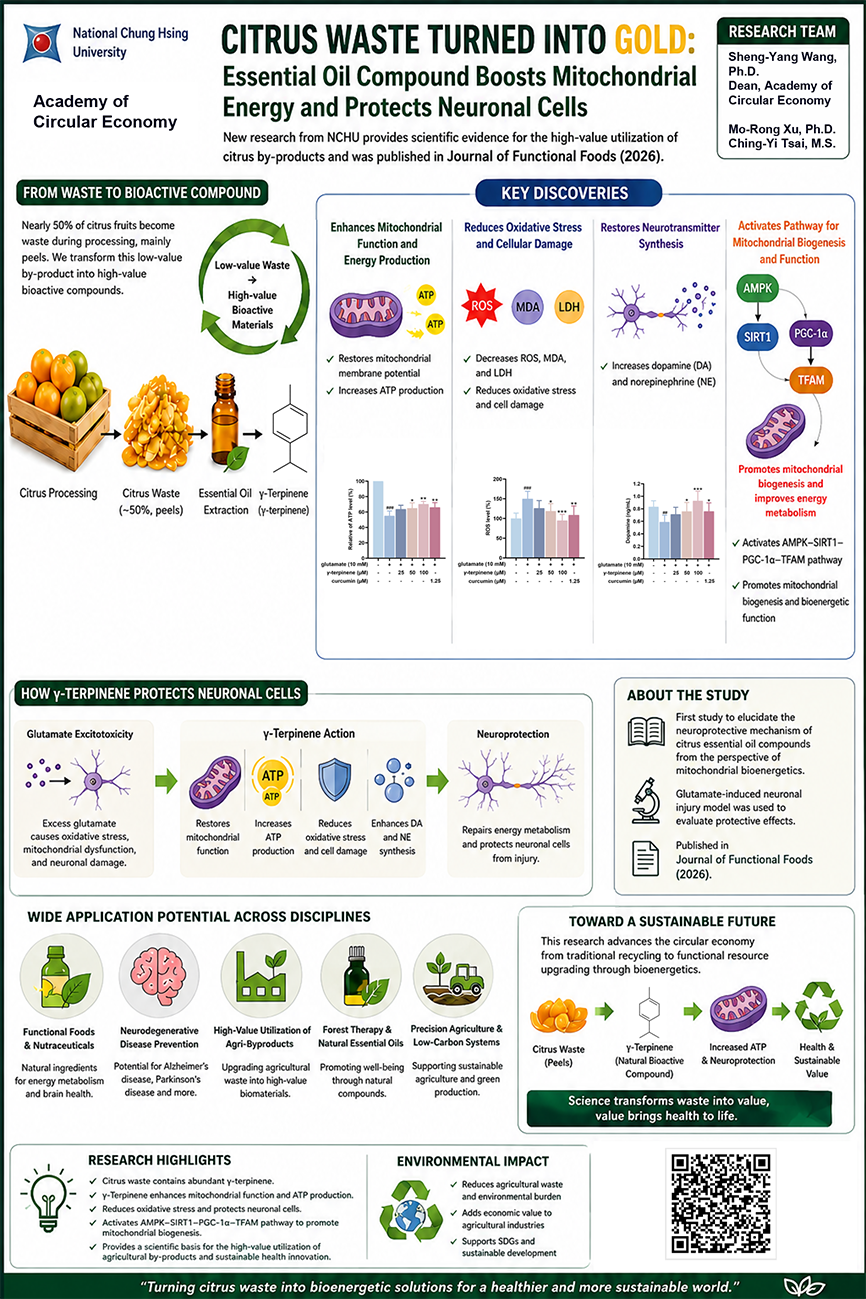
Schematic illustration of the study showing how γ-terpinene derived from citrus waste activates the AMPK–SIRT1–PGC-1α–TFAM signaling pathway, enhances mitochondrial ATP production, reduces oxidative stress, and protects neuronal cells from glutamate-induc