

NCHU and Buddhist Tzu Chi Medical Foundation Develop Off-the-Shelf iPSC-Derived Neural Spheroids, Advancing Parkinson’s Disease Cell Therapy
2026-06-16
興新聞張貼者
Unit秘書室
1,465
As global populations continue to age, neurodegenerative diseases such as Parkinson’s disease (PD) and Alzheimer’s disease are becoming increasingly prevalent. Parkinson’s disease, characterized by the progressive degeneration of dopamine-producing neurons in the brain, remains incurable. The disease gained worldwide attention through well-known patients such as legendary boxer Muhammad Ali and actor Michael J. Fox, who have both lived with the condition for many years.
Recent advances in induced pluripotent stem cell (iPSC) technology have accelerated the development of regenerative therapies for Parkinson’s disease. In Japan, iPSC-derived neuronal cell transplantation was recently approved for national health insurance reimbursement, marking a significant milestone in regenerative medicine.
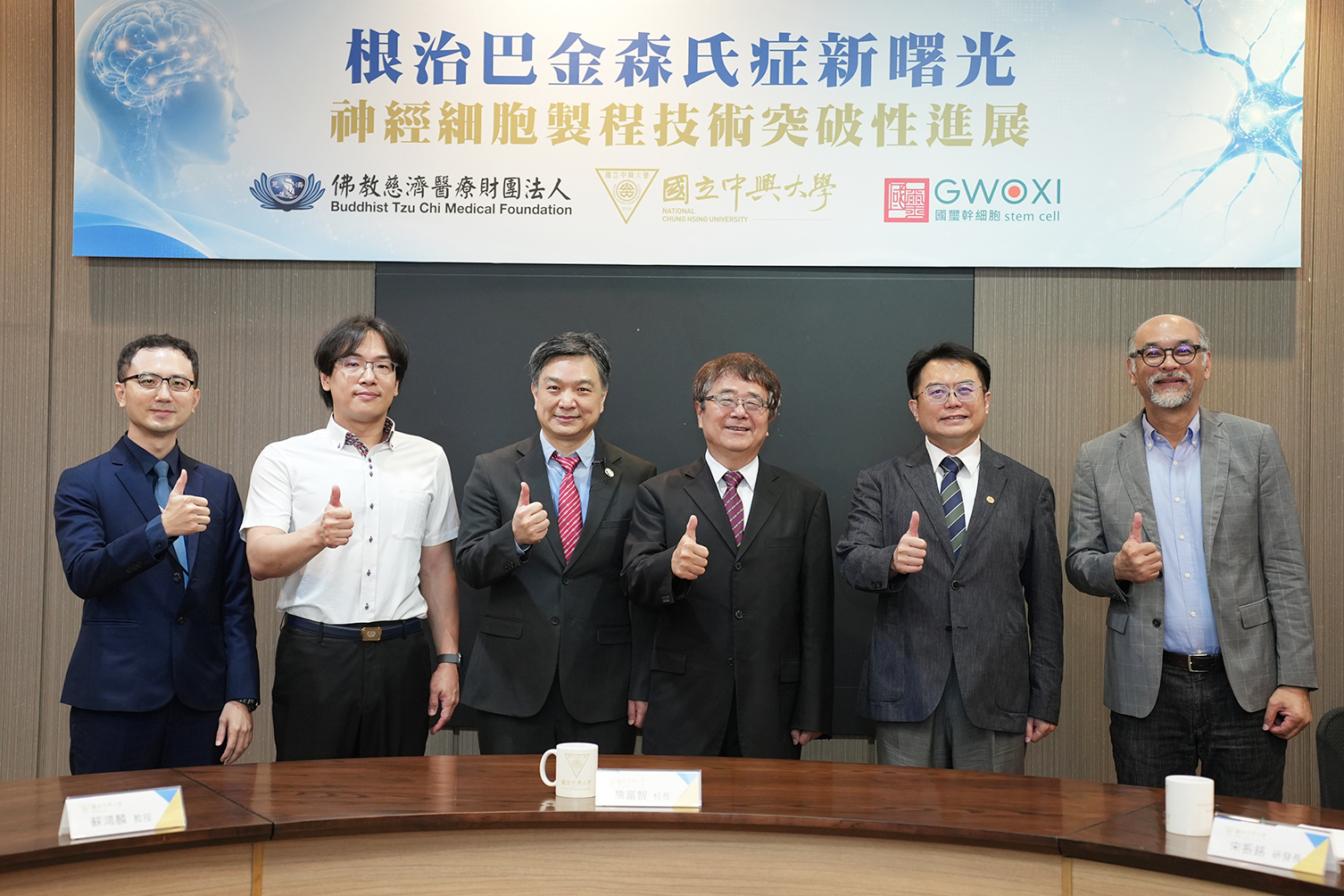
A research team led by Superintendent Shinn-Zong Lin of Hualien Tzu Chi Hospital and Dr. Chia-Yu Chang of the Tzu Chi Medical Foundation Bioinnovation Center, in collaboration with Professor Hong-Lin Su of the Department of Life Sciences at National Chung Hsing University and GWOXI stem cell, has established a cryopreservable human iPSC-derived dopaminergic progenitor cell platform. This technology addresses longstanding challenges in cell therapy, including storage, transportation, and large-scale manufacturing. The platform demonstrated rapid and sustained functional recovery in Parkinsonian animal models. The findings were published in June in npj Parkinson’s Disease, a Nature Portfolio journal, representing an important step toward the global clinical implementation of cell-based therapies for Parkinson’s disease.
Parkinson’s disease is the second most common neurodegenerative disorder worldwide. It results from the progressive loss of dopaminergic neurons in the midbrain, leading to symptoms such as tremor, muscle rigidity, bradykinesia, and gait disturbances. Current treatments, including levodopa, primarily alleviate symptoms but cannot halt ongoing neuronal degeneration. Consequently, researchers have long sought to develop cell replacement therapies capable of restoring lost dopaminergic neurons.
Recent breakthroughs in iPSC technology have brought new hope to Parkinson’s disease treatment. In 2026, Japan launched the world’s first nationally reimbursed allogeneic iPSC-derived cell therapy for Parkinson’s disease, Amchepry, demonstrating the clinical potential of dopaminergic progenitor transplantation. Nevertheless, widespread adoption of cell therapy continues to face critical challenges related to cell preservation, transportation, and therapeutic consistency. Conventional cell products often require immediate use after manufacturing, while maintaining cell viability during storage and transport remains difficult. These limitations restrict distribution, scalability, and cost-effectiveness.
The major innovation of the current study is the development of a cell product platform with true off-the-shelf potential. Using three-dimensional spheroid technology, the team successfully generated cryopreservable dopaminergic progenitor cells. The study demonstrated that these cells maintained high viability and dopaminergic characteristics even after long-term cryostorage. Following transplantation into Parkinsonian animal models, the cells produced rapid and durable functional improvements.
This technology may eventually enable cell therapy products to be manufactured at centralized GMP-compliant facilities, cryopreserved, and distributed to medical centers worldwide in a manner similar to vaccines and other biological products. Such an approach could improve product consistency, reduce manufacturing costs, and significantly increase the accessibility and scalability of regenerative therapies.
According to Superintendent Shinn-Zong Lin and Professor Hong-Lin Su, this study establishes a dopaminergic progenitor platform that combines efficient differentiation, robust cryopreservation capability, and comprehensive safety evaluation. The platform provides an important foundation for future cell-based therapies targeting neurodegenerative diseases. The team plans to continue advancing research in regenerative medicine and neuroscience, with the goal of developing safer, more effective, and more reliable cell therapy products for patients with Parkinson’s disease and other neurodegenerative disorders.
Publication
Chang CY, et al. Cryopreservable dopaminergic progenitors derived from human iPSCs with accelerated loss of pluripotency and early functional restoration in Parkinsonian rats. npj Parkinson’s Disease (2026).
Article: https://www.nature.com/articles/s41531-026-01399-4
Recent advances in induced pluripotent stem cell (iPSC) technology have accelerated the development of regenerative therapies for Parkinson’s disease. In Japan, iPSC-derived neuronal cell transplantation was recently approved for national health insurance reimbursement, marking a significant milestone in regenerative medicine.
A research team led by Superintendent Shinn-Zong Lin of Hualien Tzu Chi Hospital and Dr. Chia-Yu Chang of the Tzu Chi Medical Foundation Bioinnovation Center, in collaboration with Professor Hong-Lin Su of the Department of Life Sciences at National Chung Hsing University and GWOXI stem cell, has established a cryopreservable human iPSC-derived dopaminergic progenitor cell platform. This technology addresses longstanding challenges in cell therapy, including storage, transportation, and large-scale manufacturing. The platform demonstrated rapid and sustained functional recovery in Parkinsonian animal models. The findings were published in June in npj Parkinson’s Disease, a Nature Portfolio journal, representing an important step toward the global clinical implementation of cell-based therapies for Parkinson’s disease.
Parkinson’s disease is the second most common neurodegenerative disorder worldwide. It results from the progressive loss of dopaminergic neurons in the midbrain, leading to symptoms such as tremor, muscle rigidity, bradykinesia, and gait disturbances. Current treatments, including levodopa, primarily alleviate symptoms but cannot halt ongoing neuronal degeneration. Consequently, researchers have long sought to develop cell replacement therapies capable of restoring lost dopaminergic neurons.
Recent breakthroughs in iPSC technology have brought new hope to Parkinson’s disease treatment. In 2026, Japan launched the world’s first nationally reimbursed allogeneic iPSC-derived cell therapy for Parkinson’s disease, Amchepry, demonstrating the clinical potential of dopaminergic progenitor transplantation. Nevertheless, widespread adoption of cell therapy continues to face critical challenges related to cell preservation, transportation, and therapeutic consistency. Conventional cell products often require immediate use after manufacturing, while maintaining cell viability during storage and transport remains difficult. These limitations restrict distribution, scalability, and cost-effectiveness.
The major innovation of the current study is the development of a cell product platform with true off-the-shelf potential. Using three-dimensional spheroid technology, the team successfully generated cryopreservable dopaminergic progenitor cells. The study demonstrated that these cells maintained high viability and dopaminergic characteristics even after long-term cryostorage. Following transplantation into Parkinsonian animal models, the cells produced rapid and durable functional improvements.
This technology may eventually enable cell therapy products to be manufactured at centralized GMP-compliant facilities, cryopreserved, and distributed to medical centers worldwide in a manner similar to vaccines and other biological products. Such an approach could improve product consistency, reduce manufacturing costs, and significantly increase the accessibility and scalability of regenerative therapies.
According to Superintendent Shinn-Zong Lin and Professor Hong-Lin Su, this study establishes a dopaminergic progenitor platform that combines efficient differentiation, robust cryopreservation capability, and comprehensive safety evaluation. The platform provides an important foundation for future cell-based therapies targeting neurodegenerative diseases. The team plans to continue advancing research in regenerative medicine and neuroscience, with the goal of developing safer, more effective, and more reliable cell therapy products for patients with Parkinson’s disease and other neurodegenerative disorders.
Publication
Chang CY, et al. Cryopreservable dopaminergic progenitors derived from human iPSCs with accelerated loss of pluripotency and early functional restoration in Parkinsonian rats. npj Parkinson’s Disease (2026).
Article: https://www.nature.com/articles/s41531-026-01399-4
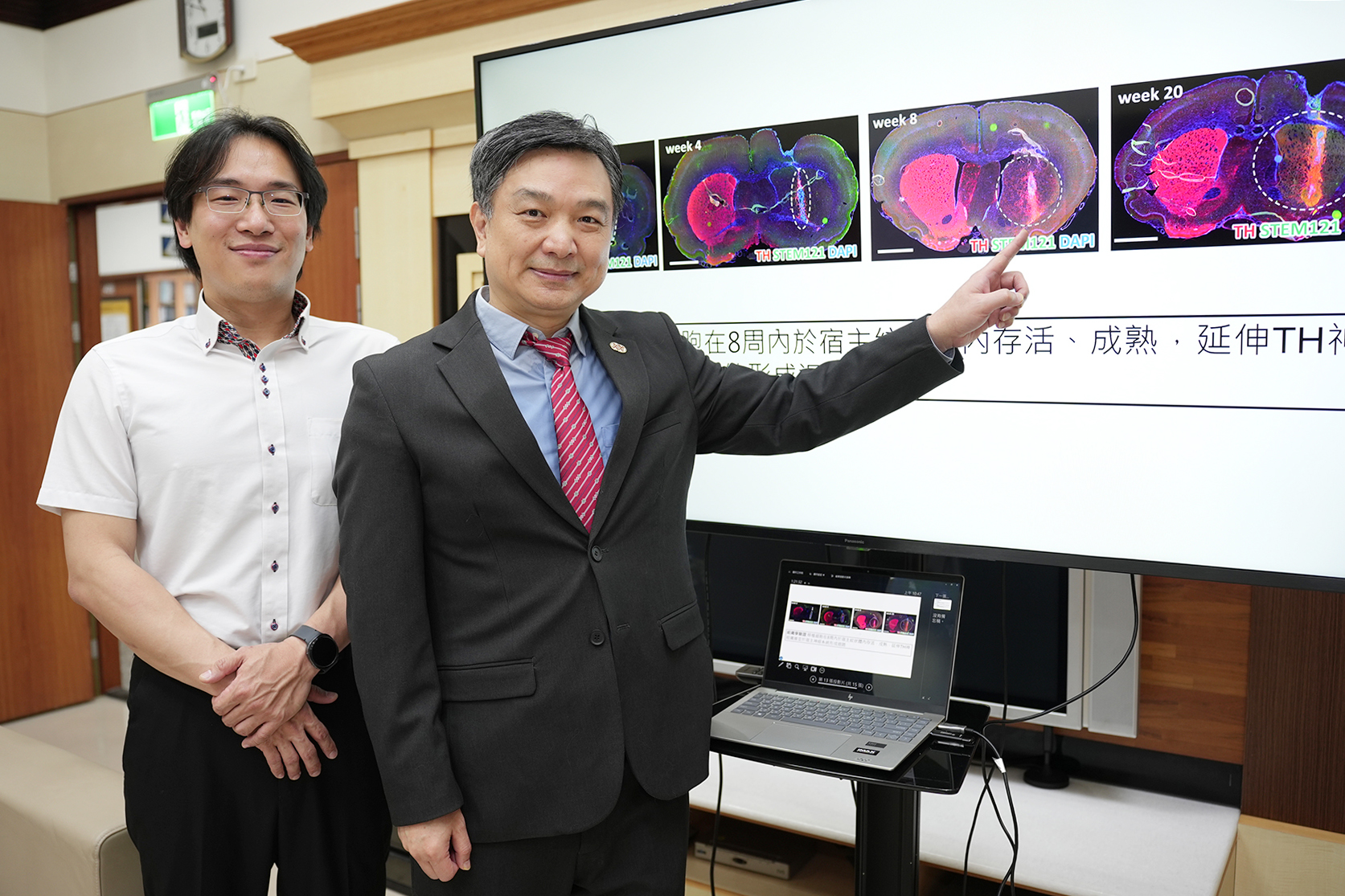
Professor Hong-Lin Su (right) of the Department of Life Sciences at National Chung Hsing University and Dr. Chia-Yu Chang (left) of the Buddhist Tzu Chi Medical Foundation jointly present their "off-the-shelf" iPSC-derived neural spheroid technology for P