

How genetic technologies can help secure and improve the nutritional value of our food crops for human health in times of climate change: Reverting a concerning negative trend
2026-06-25
興新聞張貼者
Unit秘書室
1,558
Although the world is producing more crops than ever before to feed the growing global population, more than 700 million people are still going hungry and over two billion are suffering from micronutrient deficiencies, also known as ‘hidden hunger’, which affects their everyday lives and well-being. This is particularly true for those who rely on major staple crops such as cassava, maize, rice and wheat for their daily diets. These crops are rich in starch, which provides necessary calories. However, they are generally poor sources of vitamins and minerals, collectively called micronutrients, that are critical for human health. Past breeding efforts have often favored high yields while neglecting important micronutrients. Furthermore, recent studies have raised concerns that rising CO2 levels and climate change negatively impact the nutritional content and yield of grain crops such as rice and wheat (Myers et al., 2014; Cao et al., 2026).
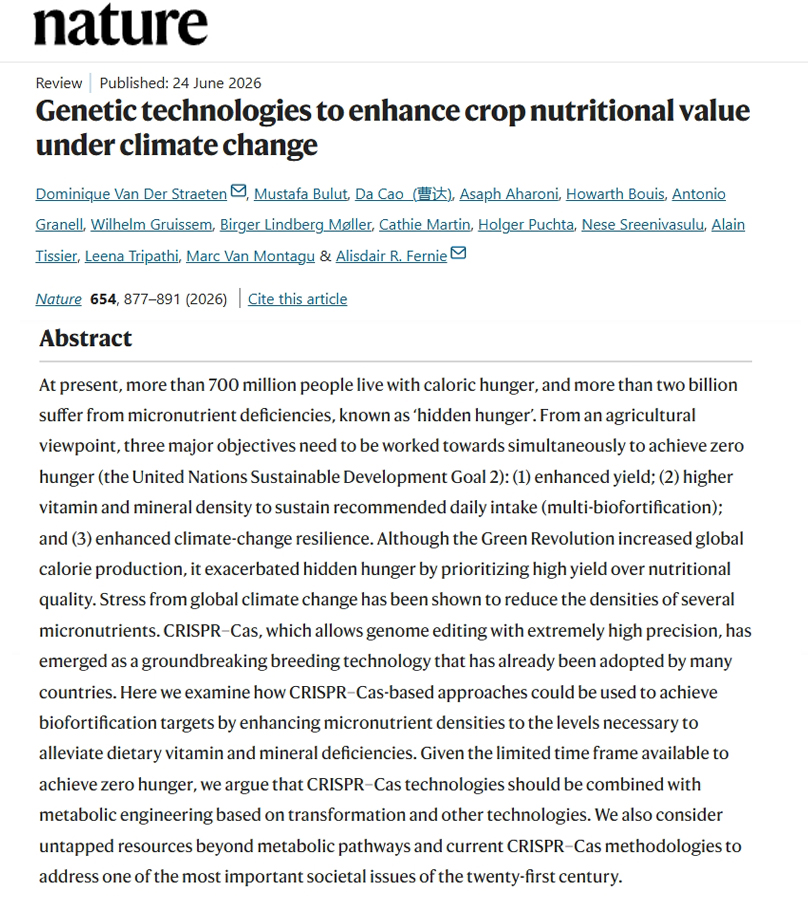
In a review published today in Nature, a team of international scientists led by Dominique Van Der Straeten of Ghent University examined how available genetic technologies could boost the vitamin and mineral content of food crops while making them more resilient to climate change (Van Der Straeten et al., 2026). CRISPR-Cas genome editing, for example, has emerged as a groundbreaking tool that many countries have already adopted to enable highly precise and rapid crop breeding. This technology can facilitate the breeding of crops with increased dietary micronutrient content and stress resilience to secure human health and the food supply. Considering the limited time available to achieve the United Nations Sustainable Development Goal of zero hunger by 2030, the scientists argue that new breeding technologies must be widely applied to address hunger and micronutrient deficiencies as pressing societal issues of the twenty-first century. Wilhelm Gruissem, a Yushan Scholar at National Chung Hsing University in Taiwan and a member of the international scientist team, emphasizes that the review provides an important framework and guidelines for much-needed research and policymaking at the national and international levels.
Van Der Straeten, D., et al. Genetic technologies to enhance crop nutritional value under climate change. Nature, 25 June 2026; https://www.nature.com/articles/s41586-026-10593-6 (DOI 10.1038/s41586-026-10593-6)
Cao, D., Michel, J., et al. Climate change threatens nutritional quality of European winter wheat. Advanced Science, 13 July 2026; 0:e13322, https://doi.org/10.1002/advs.202513322
Myers, S., Zanobetti, A., Kloog, I. et al. Increasing CO2 threatens human nutrition. Nature 510, 139–142 (2014). https://doi.org/10.1038/nature13179
Address and contact information;
Prof. Wilhelm Gruissem
Biotechnology Center, National Chung Hsing University, Taichung, Taiwan, wgruissem@nchu.edu.tw
Wilhelm Gruissem is Chair Professor and Yushan Scholar at National Chung Hsing University, Fellow of the American Academic of Arts and Sciences (AAAS) and Fellow of the American Society of Plant Biologists (ASPB), former President of the European Plant Science Organization (EPSO) and the Global Plant Council.
In a review published today in Nature, a team of international scientists led by Dominique Van Der Straeten of Ghent University examined how available genetic technologies could boost the vitamin and mineral content of food crops while making them more resilient to climate change (Van Der Straeten et al., 2026). CRISPR-Cas genome editing, for example, has emerged as a groundbreaking tool that many countries have already adopted to enable highly precise and rapid crop breeding. This technology can facilitate the breeding of crops with increased dietary micronutrient content and stress resilience to secure human health and the food supply. Considering the limited time available to achieve the United Nations Sustainable Development Goal of zero hunger by 2030, the scientists argue that new breeding technologies must be widely applied to address hunger and micronutrient deficiencies as pressing societal issues of the twenty-first century. Wilhelm Gruissem, a Yushan Scholar at National Chung Hsing University in Taiwan and a member of the international scientist team, emphasizes that the review provides an important framework and guidelines for much-needed research and policymaking at the national and international levels.
Van Der Straeten, D., et al. Genetic technologies to enhance crop nutritional value under climate change. Nature, 25 June 2026; https://www.nature.com/articles/s41586-026-10593-6 (DOI 10.1038/s41586-026-10593-6)
Cao, D., Michel, J., et al. Climate change threatens nutritional quality of European winter wheat. Advanced Science, 13 July 2026; 0:e13322, https://doi.org/10.1002/advs.202513322
Myers, S., Zanobetti, A., Kloog, I. et al. Increasing CO2 threatens human nutrition. Nature 510, 139–142 (2014). https://doi.org/10.1038/nature13179
Address and contact information;
Prof. Wilhelm Gruissem
Biotechnology Center, National Chung Hsing University, Taichung, Taiwan, wgruissem@nchu.edu.tw
Wilhelm Gruissem is Chair Professor and Yushan Scholar at National Chung Hsing University, Fellow of the American Academic of Arts and Sciences (AAAS) and Fellow of the American Society of Plant Biologists (ASPB), former President of the European Plant Science Organization (EPSO) and the Global Plant Council.