

A Novel Resistance Mechanism for Fighting Plant Virus Diseases to Ensure Food Security
2026-08-28
興新聞張貼者
Unit秘書室
840
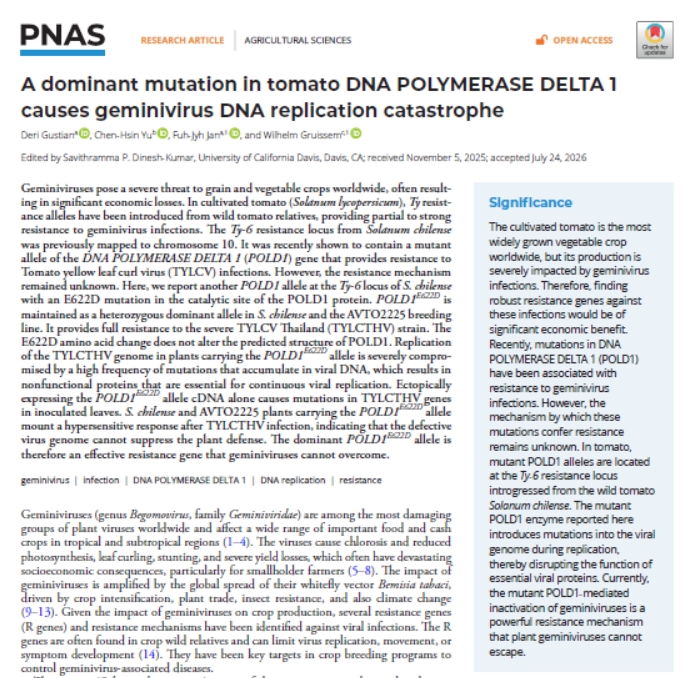
Virus diseases pose a global threat to agricultural crop production, human health, and animal health. Plant DNA viruses are among the most destructive diseases of staple food crops, vegetables, fiber crops and perennial commodities. These viruses can reduce yield and quality, and can even lead to complete crop failure during severe epidemics, especially for smallholder farmers in tropical and subtropical countries (Tatineni and Hein, 2023). Plant DNA viruses of the Geminiviridae genus are transmitted by whitefly insects. Climate change, rising temperatures, and the globalization of agriculture increase the risk of temporal and geographic insect-mediated virus transmission (Kvarnheden, 2026). An earlier study led by Prof. Wilhelm Gruissem at ETH Zurich reported that single mutations in the plant DNA replication enzyme, DNA polymerase delta 1 (POLD1), are responsible for resistance to geminivirus infections in cassava (Lim et al., 2023). Geminiviruses also use plant POLD1 to replicate their genomes. However, the effect of POLD1 mutant alleles on virus DNA replication remained unknown.
Today, in an article published in the Proceedings of the National Academy of Sciences USA, Wilhelm Gruissem and his team at National Chung Hsing University in Taiwan now reveal the mechanism by which POLD1 can prevent geminiviruses from infecting plants (Gustian et al., 2026). Using a severe variant of the Tomato Yellow Leaf Curl Virus (TYLCV), which affects global tomato production, they demonstrate that a tomato POLD1 mutant enzyme introduces mutations into the viral DNA during genome replication after infecting cultivated tomatoes and the wild tomato species Solanum chilense. These mutations disrupt the function of essential viral proteins, preventing the virus from spreading throughout the plant. The POLD1 mutant enzyme is maintained as a heterozygous allele in the wild tomato population, allowing the plants to contain the virus and thrive. The POLD1 mutant allele is currently useful for breeders because it provides a powerful resistance mechanism that plant geminiviruses cannot escape.
References:
Gustian, D., Yu, C.H., Jan, F.J. Jan and Gruissem W. (2026) A dominant mutation in tomato DNA POLYMERASE DELTA 1 causes geminivirus DNA replication catastrophe. Proceedings of the National Academy of Sciences U.S.A. 123 (35) e2531841123, https://doi.org/10.1073/pnas.2531841123
Kvarnheden, A. (2026) Challenges with insect-transmitted viruses infecting crops in a changing climate. Tropical Plant Pathology 51:37, https://doi.org/10.1007/s40858-026-00819-3
Lim, Y.W., Mansfeld, B.N., Schläpfer, P., Gilbert, K.B., Narayanan, N.N., Qi, W., Wang, Q., Zhong, Z., Boyher, A., Gehan, J., Beyene, G., Lin, Z.D., Esuma, W., Feng, S., Chanez, C., Eggenberger, N., Adiga, G., Jacobsen, S.E., Taylor, N., Bart, R.S. and Gruissem, W. (2022) Mutations in DNA polymerase subunit 1 segregate with CMD2-type resistance to Cassava Mosaic Geminiviruses. Nature Communications 13: 3933, https://doi.org/10.1038/s41467-022-31414-0
Tatineni, S. and Hein, G.L. (2023) Plant viruses of agricultural importance: current and future perspectives of virus disease management strategies. Phytopathology 113: 117-141, https://doi.org/10.1094/PHYTO-05-22-0167-RVW
For further information:
Prof. Wilhelm Gruissem and Prof. Fuh-Jyh Jan
Biotechnology Center and Department of Plant Pathology
National Chung Hsing University
145 Xingda Road
Taichung 40227, Taiwan
wgruissem@nchu.edu.tw, fjjan@nchu.edu.tw
Wilhelm Gruissem is a Distinguished Chair Professor at National Chung Hsing University, Yushan Fellow of the Ministry of Education in Taiwan, Fellow of the American Association for the Advancement of Sciences (AAAS), and Fellow of the American Society of Plant Biologists (ASPB). He is listed among the top two percent of scientists worldwide for lifetime achievements.
Fuh-Jyh Jan is a Lifetime Distinguished Professor in the Department of Plant Pathology at National Chung Hsing University (NCHU). A renowned plant virologist, he is a recipient of Taiwan’s 38th Top Ten Outstanding Agriculturalists Award. He has also served as President of the Agricultural Association of Taiwan, the Taiwan Phytopathological Society, and the Taiwan Society of Plant Biologists, and currently serves as President of NCHU.
Today, in an article published in the Proceedings of the National Academy of Sciences USA, Wilhelm Gruissem and his team at National Chung Hsing University in Taiwan now reveal the mechanism by which POLD1 can prevent geminiviruses from infecting plants (Gustian et al., 2026). Using a severe variant of the Tomato Yellow Leaf Curl Virus (TYLCV), which affects global tomato production, they demonstrate that a tomato POLD1 mutant enzyme introduces mutations into the viral DNA during genome replication after infecting cultivated tomatoes and the wild tomato species Solanum chilense. These mutations disrupt the function of essential viral proteins, preventing the virus from spreading throughout the plant. The POLD1 mutant enzyme is maintained as a heterozygous allele in the wild tomato population, allowing the plants to contain the virus and thrive. The POLD1 mutant allele is currently useful for breeders because it provides a powerful resistance mechanism that plant geminiviruses cannot escape.
References:
Gustian, D., Yu, C.H., Jan, F.J. Jan and Gruissem W. (2026) A dominant mutation in tomato DNA POLYMERASE DELTA 1 causes geminivirus DNA replication catastrophe. Proceedings of the National Academy of Sciences U.S.A. 123 (35) e2531841123, https://doi.org/10.1073/pnas.2531841123
Kvarnheden, A. (2026) Challenges with insect-transmitted viruses infecting crops in a changing climate. Tropical Plant Pathology 51:37, https://doi.org/10.1007/s40858-026-00819-3
Lim, Y.W., Mansfeld, B.N., Schläpfer, P., Gilbert, K.B., Narayanan, N.N., Qi, W., Wang, Q., Zhong, Z., Boyher, A., Gehan, J., Beyene, G., Lin, Z.D., Esuma, W., Feng, S., Chanez, C., Eggenberger, N., Adiga, G., Jacobsen, S.E., Taylor, N., Bart, R.S. and Gruissem, W. (2022) Mutations in DNA polymerase subunit 1 segregate with CMD2-type resistance to Cassava Mosaic Geminiviruses. Nature Communications 13: 3933, https://doi.org/10.1038/s41467-022-31414-0
Tatineni, S. and Hein, G.L. (2023) Plant viruses of agricultural importance: current and future perspectives of virus disease management strategies. Phytopathology 113: 117-141, https://doi.org/10.1094/PHYTO-05-22-0167-RVW
For further information:
Prof. Wilhelm Gruissem and Prof. Fuh-Jyh Jan
Biotechnology Center and Department of Plant Pathology
National Chung Hsing University
145 Xingda Road
Taichung 40227, Taiwan
wgruissem@nchu.edu.tw, fjjan@nchu.edu.tw
Wilhelm Gruissem is a Distinguished Chair Professor at National Chung Hsing University, Yushan Fellow of the Ministry of Education in Taiwan, Fellow of the American Association for the Advancement of Sciences (AAAS), and Fellow of the American Society of Plant Biologists (ASPB). He is listed among the top two percent of scientists worldwide for lifetime achievements.
Fuh-Jyh Jan is a Lifetime Distinguished Professor in the Department of Plant Pathology at National Chung Hsing University (NCHU). A renowned plant virologist, he is a recipient of Taiwan’s 38th Top Ten Outstanding Agriculturalists Award. He has also served as President of the Agricultural Association of Taiwan, the Taiwan Phytopathological Society, and the Taiwan Society of Plant Biologists, and currently serves as President of NCHU.