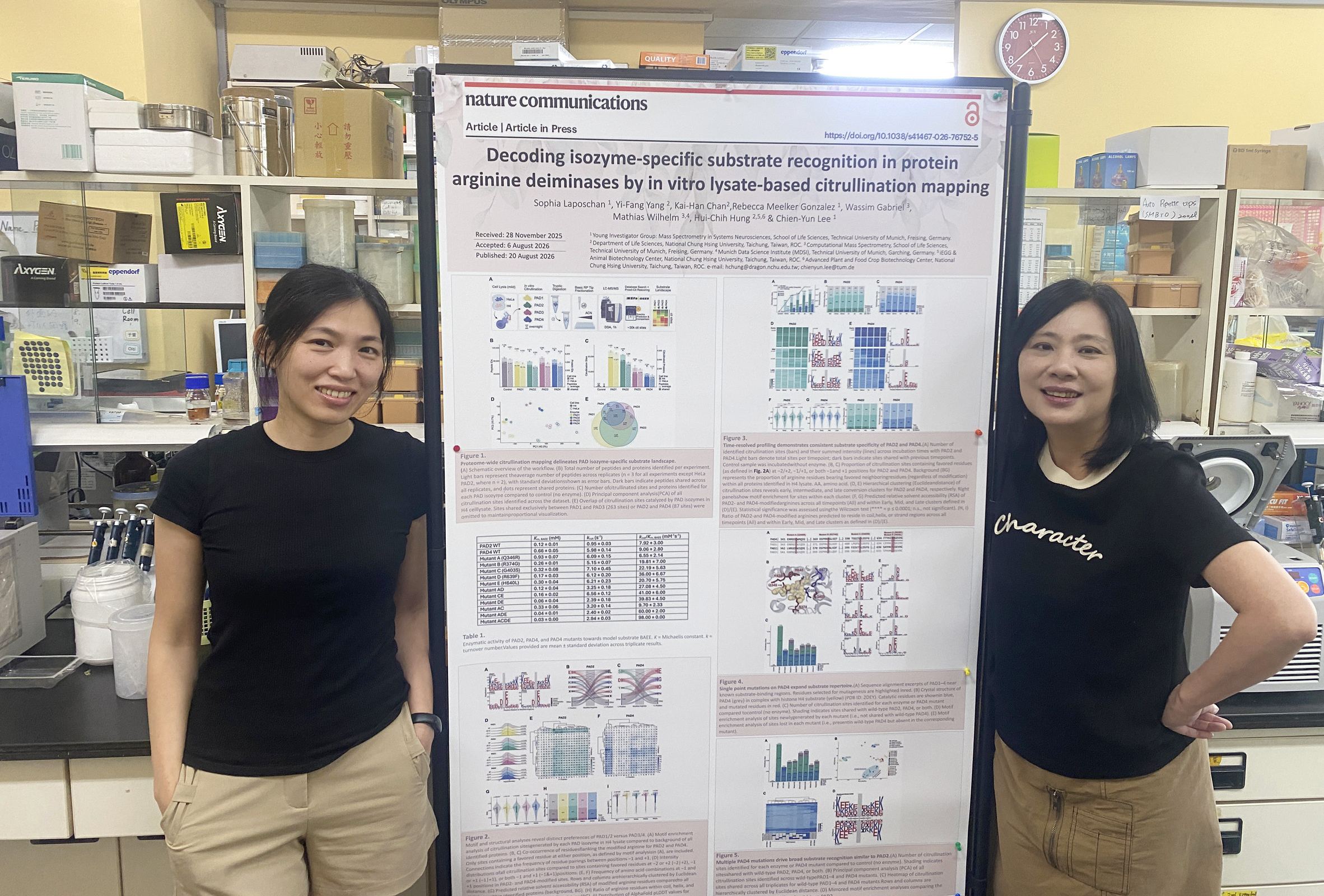


NCHU Professor Hui-Chih Hung and German Collaborators Decode How PAD Enzymes Recognize Their Protein Substrates in Nature Communications
2026-09-17
興新聞張貼者
Unit秘書室
613
A scientific question first raised in the laboratory of Professor Hui-Chih Hung at the Department of Life Sciences, National Chung Hsing University (NCHU), has grown into a major international research achievement. Through years of collaboration and the continued efforts of successive generations of researchers, Hung’s team joined forces with Dr. Chien-Yun Lee’s group at the Technical University of Munich (TUM), Germany, to uncover the molecular basis by which protein arginine deiminase (PAD) enzymes distinguish among different protein substrates.
The findings, published in the international journal Nature Communications, mark an important advance in understanding PAD substrate specificity. They also tell a compelling story of scientific collaboration and talent development spanning Taiwan and Germany.
After proteins are synthesized in cells, they can undergo a wide range of post-translational modifications that alter their structure, activity, and biological function. One such modification, protein citrullination, is closely associated with immune regulation, gene expression, and numerous diseases. Yet a fundamental question has remained unresolved: How do closely related enzymes within the same family recognize and modify different protein substrates?
In the study, titled “Decoding isozyme-specific substrate recognition in protein arginine deiminases by in vitro lysate-based citrullination mapping,” Professor Hui-Chih Hung of NCHU and Dr. Chien-Yun Lee of TUM served as co-corresponding authors, with NCHU alumna Dr. Yi-Fang Yang as the second author. By integrating protein science, enzymology, large-scale mass spectrometry-based proteomics, and computational analysis, the researchers systematically compared the four catalytically active human PAD isozymes—PAD1, PAD2, PAD3, and PAD4.
The team established a large-scale in vitro atlas of PAD-mediated protein citrullination and identified a set of key amino acids that governs the highly selective substrate-recognition behavior of PAD4.
Nearly 30,000 Citrullination Sites Reveal the Substrate-Recognition Code of PAD Enzymes
Protein arginine deiminases are calcium-dependent enzymes that convert arginine residues within proteins into citrulline. Abnormal PAD activity has been linked to rheumatoid arthritis, multiple sclerosis, Alzheimer’s disease, and various cancers. Understanding how individual PAD isozymes select their protein substrates is therefore important not only for fundamental biology but also for elucidating disease mechanisms and developing new therapeutic strategies.
To recreate a complex protein environment, the researchers used human cell lysates together with recombinant PAD1–4 enzymes, high-resolution mass spectrometry, and machine-learning analysis. They identified 29,485 citrullination sites across 5,480 proteins. Only approximately 14% of these sites were shared by all four PAD isozymes, demonstrating that despite their structural similarity, the enzymes possess markedly different substrate preferences.
PAD1 and PAD2 displayed relatively broad substrate specificity, whereas PAD3 and PAD4 were considerably more selective. Among the four enzymes, PAD4 showed the most restricted pattern of substrate recognition.
The researchers then combined structural analysis with site-directed mutagenesis to identify four amino acid residues—Q346, G403, R639, and H640—as key determinants of PAD4 substrate specificity. When these residues were progressively replaced with the corresponding amino acids found in PAD2, the normally selective PAD4 enzyme began to recognize a broader range of substrates. When all four residues were substituted simultaneously, PAD4 adopted a substrate-recognition profile strikingly similar to that of PAD2.
The study therefore goes beyond creating a comprehensive map of PAD substrates. It provides molecular-level insight into how highly homologous enzyme isozymes develop distinct substrate specificities. These findings may offer an important foundation for investigating PAD-associated diseases and for developing isozyme-selective inhibitors and molecular probes.
Postcards from Germany: A Scientific Journey Across Generations
The publication also represents the culmination of a long-running story of mentorship, scientific curiosity, and international collaboration.
Dr. Chien-Yun Lee first began investigating how PAD4 selects its protein substrates while pursuing her doctoral degree in Professor Hung’s laboratory at NCHU. She later received support from Taiwan’s National Science and Technology Council through the Postdoctoral Research Abroad Program and continued her research at the Technical University of Munich. There, she brought mass spectrometry-based proteomics and large-scale data analysis into the project, while Professor Hung’s team contributed its expertise in protein science, enzymology, and structure–function analysis.
Professor Hung still keeps the postcards that Lee sent her from abroad during those years. “A scientific question first planted in a laboratory may travel much farther with a student,” Hung said. “Years later, when that student returns with new technologies and capabilities and we are finally able to answer the question together, there is nothing more rewarding for a mentor.”
The paper also reflects the strength of scientific training and continuity within NCHU’s Department of Life Sciences. Second author Dr. Yi-Fang Yang is also an alumna of the department and a former member of Professor Hung’s laboratory. She was the first author of the team’s 2025 Proceedings of the National Academy of Sciences study on the regulation of p53 by PAD4-mediated citrullination.
“Chien-Yun and Yi-Fang were both outstanding undergraduate students in the Department of Life Sciences,” Hung said. “Watching them grow from university students into independent researchers capable of addressing major scientific questions and contributing to international collaborations gives this paper a meaning that extends far beyond the research findings themselves. It represents the development of scientific talent in the truest sense.”
From a laboratory bench at NCHU to a mass spectrometry platform in Munich, the project began with a question posed by a teacher and her students and ultimately grew into an international scientific achievement. More than a study of PAD substrate specificity, the paper is a story written through scientific exploration, cross-border collaboration, mentorship, and the passing of knowledge from one generation of researchers to the next.
Source: Nature Communications: “Decoding isozyme-specific substrate recognition in protein arginine deiminases by in vitro lysate-based citrullination mapping”
The findings, published in the international journal Nature Communications, mark an important advance in understanding PAD substrate specificity. They also tell a compelling story of scientific collaboration and talent development spanning Taiwan and Germany.
After proteins are synthesized in cells, they can undergo a wide range of post-translational modifications that alter their structure, activity, and biological function. One such modification, protein citrullination, is closely associated with immune regulation, gene expression, and numerous diseases. Yet a fundamental question has remained unresolved: How do closely related enzymes within the same family recognize and modify different protein substrates?
In the study, titled “Decoding isozyme-specific substrate recognition in protein arginine deiminases by in vitro lysate-based citrullination mapping,” Professor Hui-Chih Hung of NCHU and Dr. Chien-Yun Lee of TUM served as co-corresponding authors, with NCHU alumna Dr. Yi-Fang Yang as the second author. By integrating protein science, enzymology, large-scale mass spectrometry-based proteomics, and computational analysis, the researchers systematically compared the four catalytically active human PAD isozymes—PAD1, PAD2, PAD3, and PAD4.
The team established a large-scale in vitro atlas of PAD-mediated protein citrullination and identified a set of key amino acids that governs the highly selective substrate-recognition behavior of PAD4.
Nearly 30,000 Citrullination Sites Reveal the Substrate-Recognition Code of PAD Enzymes
Protein arginine deiminases are calcium-dependent enzymes that convert arginine residues within proteins into citrulline. Abnormal PAD activity has been linked to rheumatoid arthritis, multiple sclerosis, Alzheimer’s disease, and various cancers. Understanding how individual PAD isozymes select their protein substrates is therefore important not only for fundamental biology but also for elucidating disease mechanisms and developing new therapeutic strategies.
To recreate a complex protein environment, the researchers used human cell lysates together with recombinant PAD1–4 enzymes, high-resolution mass spectrometry, and machine-learning analysis. They identified 29,485 citrullination sites across 5,480 proteins. Only approximately 14% of these sites were shared by all four PAD isozymes, demonstrating that despite their structural similarity, the enzymes possess markedly different substrate preferences.
PAD1 and PAD2 displayed relatively broad substrate specificity, whereas PAD3 and PAD4 were considerably more selective. Among the four enzymes, PAD4 showed the most restricted pattern of substrate recognition.
The researchers then combined structural analysis with site-directed mutagenesis to identify four amino acid residues—Q346, G403, R639, and H640—as key determinants of PAD4 substrate specificity. When these residues were progressively replaced with the corresponding amino acids found in PAD2, the normally selective PAD4 enzyme began to recognize a broader range of substrates. When all four residues were substituted simultaneously, PAD4 adopted a substrate-recognition profile strikingly similar to that of PAD2.
The study therefore goes beyond creating a comprehensive map of PAD substrates. It provides molecular-level insight into how highly homologous enzyme isozymes develop distinct substrate specificities. These findings may offer an important foundation for investigating PAD-associated diseases and for developing isozyme-selective inhibitors and molecular probes.
Postcards from Germany: A Scientific Journey Across Generations
The publication also represents the culmination of a long-running story of mentorship, scientific curiosity, and international collaboration.
Dr. Chien-Yun Lee first began investigating how PAD4 selects its protein substrates while pursuing her doctoral degree in Professor Hung’s laboratory at NCHU. She later received support from Taiwan’s National Science and Technology Council through the Postdoctoral Research Abroad Program and continued her research at the Technical University of Munich. There, she brought mass spectrometry-based proteomics and large-scale data analysis into the project, while Professor Hung’s team contributed its expertise in protein science, enzymology, and structure–function analysis.
Professor Hung still keeps the postcards that Lee sent her from abroad during those years. “A scientific question first planted in a laboratory may travel much farther with a student,” Hung said. “Years later, when that student returns with new technologies and capabilities and we are finally able to answer the question together, there is nothing more rewarding for a mentor.”
The paper also reflects the strength of scientific training and continuity within NCHU’s Department of Life Sciences. Second author Dr. Yi-Fang Yang is also an alumna of the department and a former member of Professor Hung’s laboratory. She was the first author of the team’s 2025 Proceedings of the National Academy of Sciences study on the regulation of p53 by PAD4-mediated citrullination.
“Chien-Yun and Yi-Fang were both outstanding undergraduate students in the Department of Life Sciences,” Hung said. “Watching them grow from university students into independent researchers capable of addressing major scientific questions and contributing to international collaborations gives this paper a meaning that extends far beyond the research findings themselves. It represents the development of scientific talent in the truest sense.”
From a laboratory bench at NCHU to a mass spectrometry platform in Munich, the project began with a question posed by a teacher and her students and ultimately grew into an international scientific achievement. More than a study of PAD substrate specificity, the paper is a story written through scientific exploration, cross-border collaboration, mentorship, and the passing of knowledge from one generation of researchers to the next.
Source: Nature Communications: “Decoding isozyme-specific substrate recognition in protein arginine deiminases by in vitro lysate-based citrullination mapping”