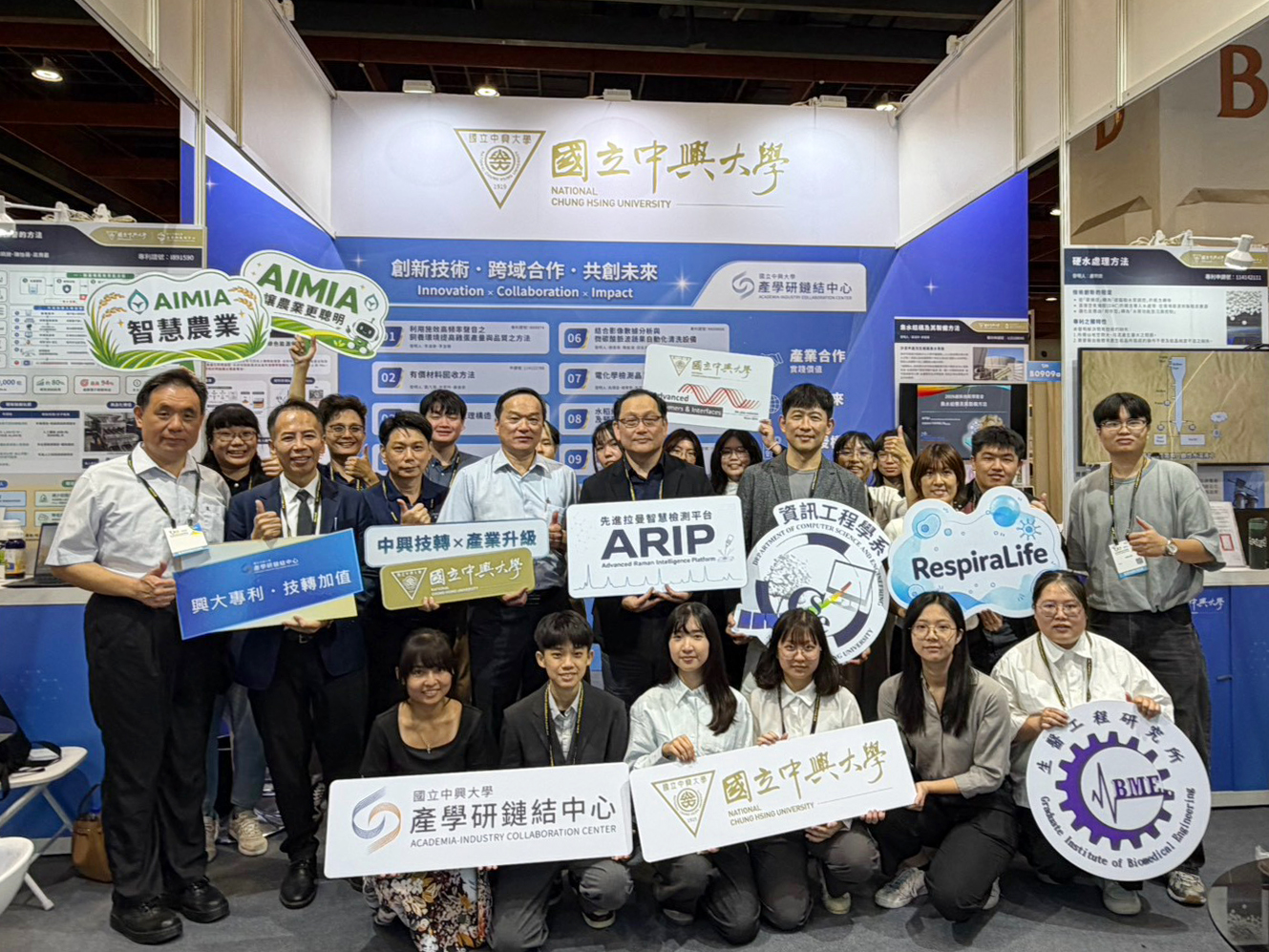


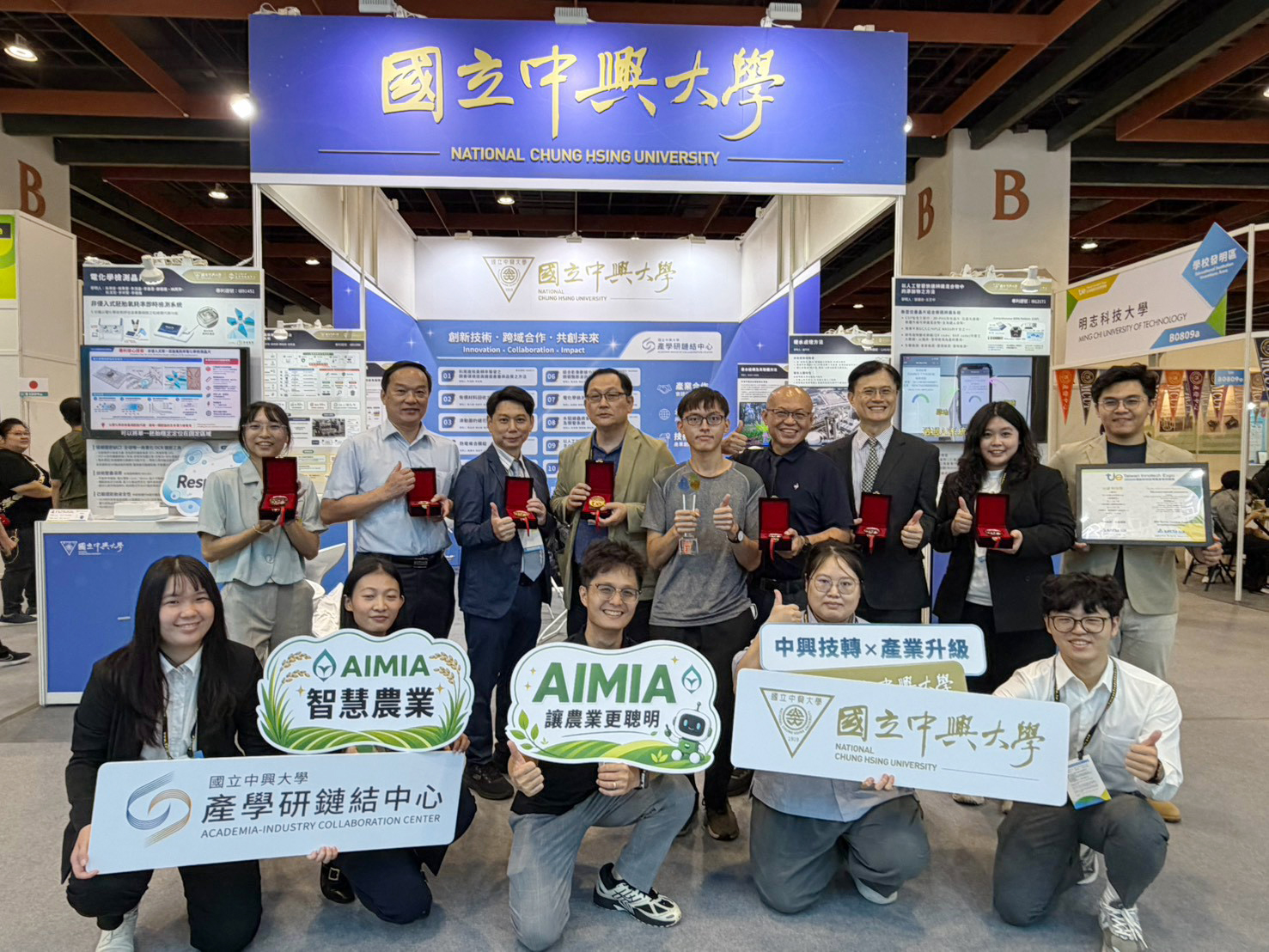
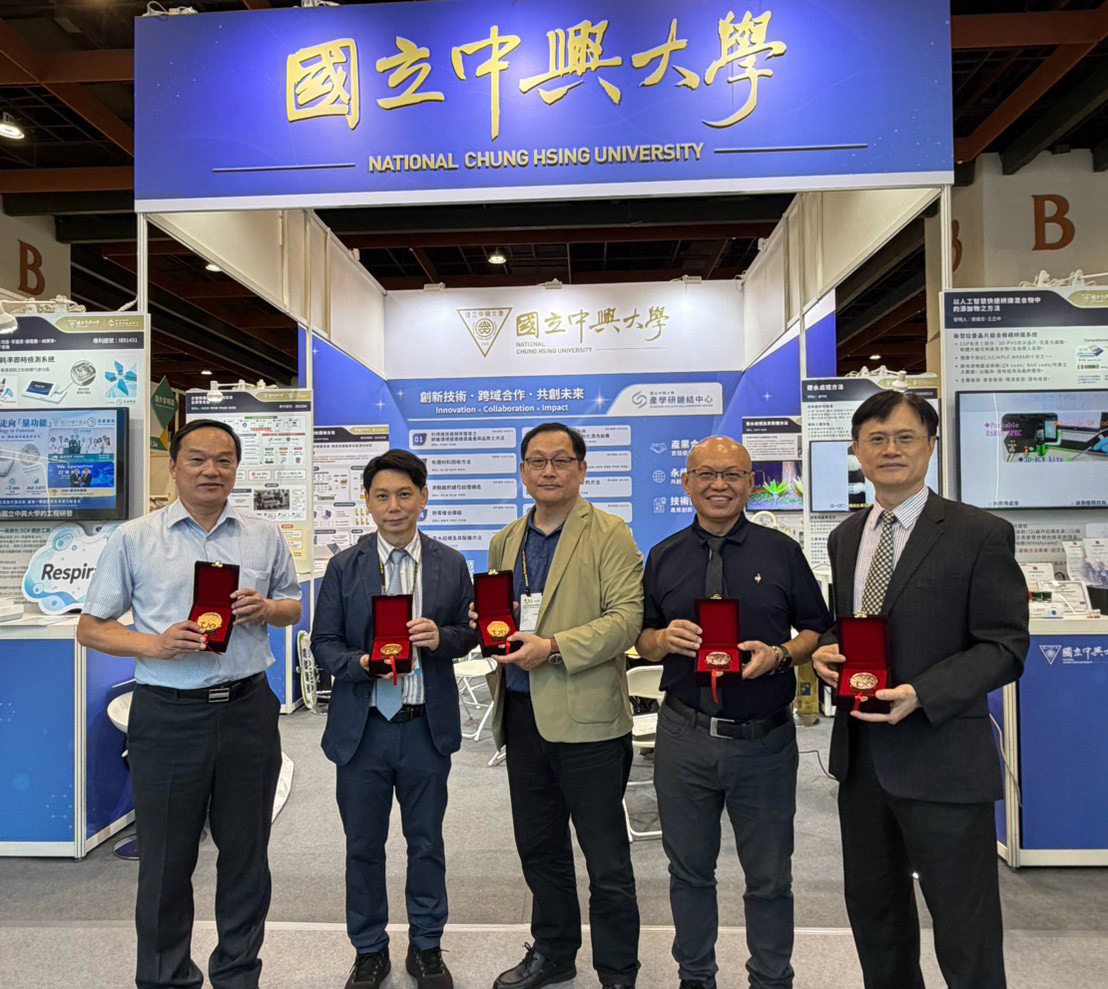
2026 Taiwan Innovation Technology Expo Invention Competition: National Chung Hsing University Wins 1 Platinum, 3 Gold, 4 Silver, 1 Bronze, and 1 Electronics Special Awards
2026-09-21
興新聞張貼者
Unit秘書室
836
Source: Academia-Industry Collaboration Center, National Chung Hsing University
The 2026 Taiwan Innovation Technology Expo held its awards ceremony on September 19. Organized by the Intellectual Property Office of the Ministry of Economic Affairs, this year's “Invention Competition Zone” attracted nearly 600 entries. Delegations from South Korea, Indonesia, Thailand, and other countries participated, demonstrating the invention community's high regard for the Platinum Award and the intense competition for it. National Chung Hsing University achieved outstanding results, securing 1 Platinum, 3 Gold, 4 Silver, 1 Bronze, and 1 Electronics Special awards. Research fields spanned agricultural biotechnology, precision machinery, smart sensing, biomedical testing, and materials chemistry. Multiple enterprises actively pursued technology transfer and industry-academia collaboration.
Platinum Award-Winning Technologies:
Professor Jhy-Cherng Tsai: The texture construction of this patented technology is designed based on mechanical principles and tribology science. It consists of multiple oil grooves, with recessed oil pockets at the intersections. The texture is configured according to the required contact area ratio to achieve optimal tribological performance. Replacing manual scraping with stable machining ensures precise control over the performance of slide rails in high-value equipment. This patented technology was simultaneously licensed to four leading domestic machine tool manufacturers — Yeong Chin Machinery Industries Co., Ltd., Goodway Machine, Co., Awea Mechantronic Co., Ltd., and Kao Fong Machinery Co., Ltd. — on May 7, 2026, to lead Taiwan's high-end machine tool industry towards digitization and standardization.
Gold Award-Winning Technologies:
1. Distinguished Professor Chien-Chung Chang & Distinguished Professor Pi-Chung Wang: Serving as a guardian of One Health, the next-generation Composite Sensing Platform (CSP) is entirely designed and developed by the team, from sensing chips and detection instruments to software. The platform features low maintenance costs and delivers testing and identification performance that meets national-level standards, while maintaining the speed and affordability of rapid screening. CSP has already been successfully applied to testing in the fields of food safety, environmental safety, and biomedical healthcare.
2. Distinguished Professor Yen-Wei Chu and Professor Pei-Chen Chen and their team developed a rice nematode disease early-warning system that integrates hyperspectral imaging and AI technology to non-destructively identify disease risks in rice seeds. The system can be integrated into existing seedling production workflows to enable disease prevention before sowing, reducing disease risk by 92%–94% while also lowering subsequent pesticide use and yield-loss risks.
3. Chair Professor Ming-Chun Lu: This invention is applied to the removal of hardness in drinking water. The process first uses an alkaline solution to absorb carbon dioxide from the air, forming carbonate, which then reacts with calcium ions in the water to generate crystalline particles. The technology achieves a high conversion rate and produces high‑purity calcium carbonate particles that can be directly recovered and reused, thereby realizing genuine carbon reduction.
Silver Award-Winning Technologies:
1. Distinguished Professor Jing-Chou Wu: Electrochemistry Detection Chip features a non-invasive detection technology capable of quantifying mitochondrial functions in single embryos or cellular spheroids. Designed to precisely guide embryos or spheroids to the center of the microstructure while controlling the electrode distance, the chip significantly improves operational convenience and measurement precision. This technology provides an efficient, reliable, and innovative solution for cellular mitochondrial function assessment.
2. Distinguished Professor Ching-Liang Dai: This technology presents a CMOS-compatible hybrid photovoltaic-thermoelectric energy harvesting chip. By integrating a photovoltaic unit for harvesting ambient light energy with a thermoelectric unit for recovering waste heat generated under illumination, the proposed dual-source energy harvesting architecture significantly improves energy utilization efficiency and power supply stability, enabling long-term self-sustained operation for low-power electronic systems.
3. Distinguished Professor Tzu-Tai Lee and Yi-Chen Li have jointly developed a "Method Of Improving Egg Production And Quality By Using A High-Frequency Sound Environment," which has been granted Taiwan Invention Patent No. I898874. This method involves playing sound within a specific high-frequency range (3,951.07 Hz – 3,986.99 Hz) at a volume of 50 to 90 dB to laying hens for a predetermined duration. It effectively improves egg quality, enhances production efficiency, and promotes healthy gut microbiota in laying hens, showcasing an innovative achievement that integrates sound technology with livestock production.
4. Professor Han-Yu Hsueh: Drawing inspiration from the desert beetle, the team designed a high-efficiency fog-harvesting composites featuring hydrophilic bumps and hydrophobic channels. The technology operates completely power-free, capturing airborne moisture in cold, foggy conditions and rapidly draining it for storage, multiplying water collection efficiency compared to traditional nets.
Bronze Award-Winning Technology:
1. Distinguished Professor Chang-Wei Hsieh: This technology integrates machine-vision inspection with micro-carbonated pulse washing in an automated fruit-cleaning system. Machine vision grades each fruit by its scale-insect count; the system then generates carbon dioxide bubbles averaging 74.4 nm in diameter, whose collapse physically dislodges insects from surface crevices without any chemical agent. At six seconds per fruit, all scale insects are removed from qualified fruit, reducing export quarantine risk.
For technology transfer and commercialization inquiries regarding the above technologies, or for further information, please contact the Patent and Technology Transfer Division of the Industry-Academia-Research Linkage Center at National Chung Hsing University. Tel: 04-22840558 ext. 20.21 Email: tto@nchu.edu.tw
The 2026 Taiwan Innovation Technology Expo held its awards ceremony on September 19. Organized by the Intellectual Property Office of the Ministry of Economic Affairs, this year's “Invention Competition Zone” attracted nearly 600 entries. Delegations from South Korea, Indonesia, Thailand, and other countries participated, demonstrating the invention community's high regard for the Platinum Award and the intense competition for it. National Chung Hsing University achieved outstanding results, securing 1 Platinum, 3 Gold, 4 Silver, 1 Bronze, and 1 Electronics Special awards. Research fields spanned agricultural biotechnology, precision machinery, smart sensing, biomedical testing, and materials chemistry. Multiple enterprises actively pursued technology transfer and industry-academia collaboration.
Platinum Award-Winning Technologies:
Professor Jhy-Cherng Tsai: The texture construction of this patented technology is designed based on mechanical principles and tribology science. It consists of multiple oil grooves, with recessed oil pockets at the intersections. The texture is configured according to the required contact area ratio to achieve optimal tribological performance. Replacing manual scraping with stable machining ensures precise control over the performance of slide rails in high-value equipment. This patented technology was simultaneously licensed to four leading domestic machine tool manufacturers — Yeong Chin Machinery Industries Co., Ltd., Goodway Machine, Co., Awea Mechantronic Co., Ltd., and Kao Fong Machinery Co., Ltd. — on May 7, 2026, to lead Taiwan's high-end machine tool industry towards digitization and standardization.
Gold Award-Winning Technologies:
1. Distinguished Professor Chien-Chung Chang & Distinguished Professor Pi-Chung Wang: Serving as a guardian of One Health, the next-generation Composite Sensing Platform (CSP) is entirely designed and developed by the team, from sensing chips and detection instruments to software. The platform features low maintenance costs and delivers testing and identification performance that meets national-level standards, while maintaining the speed and affordability of rapid screening. CSP has already been successfully applied to testing in the fields of food safety, environmental safety, and biomedical healthcare.
2. Distinguished Professor Yen-Wei Chu and Professor Pei-Chen Chen and their team developed a rice nematode disease early-warning system that integrates hyperspectral imaging and AI technology to non-destructively identify disease risks in rice seeds. The system can be integrated into existing seedling production workflows to enable disease prevention before sowing, reducing disease risk by 92%–94% while also lowering subsequent pesticide use and yield-loss risks.
3. Chair Professor Ming-Chun Lu: This invention is applied to the removal of hardness in drinking water. The process first uses an alkaline solution to absorb carbon dioxide from the air, forming carbonate, which then reacts with calcium ions in the water to generate crystalline particles. The technology achieves a high conversion rate and produces high‑purity calcium carbonate particles that can be directly recovered and reused, thereby realizing genuine carbon reduction.
Silver Award-Winning Technologies:
1. Distinguished Professor Jing-Chou Wu: Electrochemistry Detection Chip features a non-invasive detection technology capable of quantifying mitochondrial functions in single embryos or cellular spheroids. Designed to precisely guide embryos or spheroids to the center of the microstructure while controlling the electrode distance, the chip significantly improves operational convenience and measurement precision. This technology provides an efficient, reliable, and innovative solution for cellular mitochondrial function assessment.
2. Distinguished Professor Ching-Liang Dai: This technology presents a CMOS-compatible hybrid photovoltaic-thermoelectric energy harvesting chip. By integrating a photovoltaic unit for harvesting ambient light energy with a thermoelectric unit for recovering waste heat generated under illumination, the proposed dual-source energy harvesting architecture significantly improves energy utilization efficiency and power supply stability, enabling long-term self-sustained operation for low-power electronic systems.
3. Distinguished Professor Tzu-Tai Lee and Yi-Chen Li have jointly developed a "Method Of Improving Egg Production And Quality By Using A High-Frequency Sound Environment," which has been granted Taiwan Invention Patent No. I898874. This method involves playing sound within a specific high-frequency range (3,951.07 Hz – 3,986.99 Hz) at a volume of 50 to 90 dB to laying hens for a predetermined duration. It effectively improves egg quality, enhances production efficiency, and promotes healthy gut microbiota in laying hens, showcasing an innovative achievement that integrates sound technology with livestock production.
4. Professor Han-Yu Hsueh: Drawing inspiration from the desert beetle, the team designed a high-efficiency fog-harvesting composites featuring hydrophilic bumps and hydrophobic channels. The technology operates completely power-free, capturing airborne moisture in cold, foggy conditions and rapidly draining it for storage, multiplying water collection efficiency compared to traditional nets.
Bronze Award-Winning Technology:
1. Distinguished Professor Chang-Wei Hsieh: This technology integrates machine-vision inspection with micro-carbonated pulse washing in an automated fruit-cleaning system. Machine vision grades each fruit by its scale-insect count; the system then generates carbon dioxide bubbles averaging 74.4 nm in diameter, whose collapse physically dislodges insects from surface crevices without any chemical agent. At six seconds per fruit, all scale insects are removed from qualified fruit, reducing export quarantine risk.
For technology transfer and commercialization inquiries regarding the above technologies, or for further information, please contact the Patent and Technology Transfer Division of the Industry-Academia-Research Linkage Center at National Chung Hsing University. Tel: 04-22840558 ext. 20.21 Email: tto@nchu.edu.tw
2026 Taiwan Innovation Technology Expo Invention Competition: National Chung Hsing University Wins 1 Platinum, 3 Gold, 4 Silver, 1 Bronze, and 1 Electronics Special Awards
2026 Taiwan Innovation Technology Expo Invention Competition: National Chung Hsing University Wins 1 Platinum, 3 Gold, 4 Silver, 1 Bronze, and 1 Electronics Special Awards