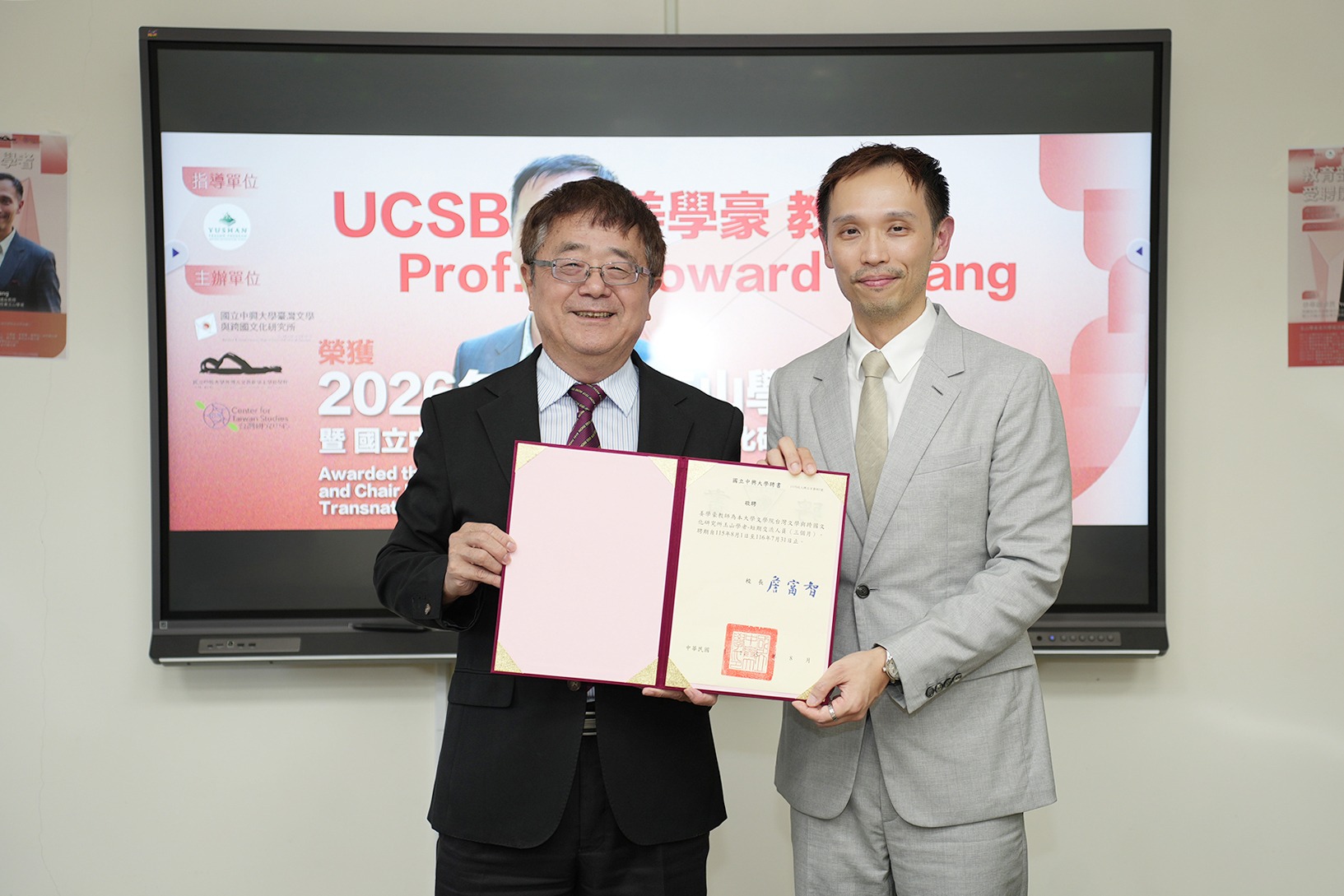


Howard Chiang named Yushan Scholar to advance Taiwan studies across the Pacific
2026-10-19
興新聞張貼者
Unit秘書室
55
Source:2026-10-19/University of California, Santa Barbara
The three-year appointment will deepen ties between UC Santa Barbara and National Chung Hsing University through research, cultural exchange and support for emerging scholars.
Food and migration, semiconductor manufacturing and the future of democracy: For UC Santa Barbara historian Howard Chiang, studying Taiwan means following questions that cross oceans and disciplines.
His selection as a Yushan Scholar by Taiwan’s Ministry of Education will give him sustained time in Taiwan to pursue those questions. The three-year appointment will deepen a collaboration between UCSB’s Center for Taiwan Studies, which he directs, and National Chung Hsing University in Taichung, Taiwan.
Chiang is NCHU’s first Yushan Scholar with a background in the humanities, according to Min-xu Zhan, an associate professor in its Graduate Institute of Taiwan Literature and Transnational Cultural Studies who coordinated the successful application.
“With his support, NCHU hopes to build an international, interdisciplinary research team,” Zhan said. “I believe this is an invaluable opportunity for both the institute’s development and its students.”
Chiang holds UCSB’s Lai Ho & Wu Cho-liu Endowed Chair in Taiwan Studies and is a professor of East Asian languages and cultural studies. He will continue his faculty and leadership roles at UCSB while serving as an honorary chair professor at NCHU’s institute through July 2029. The appointment began Aug. 1, 2026, and requires at least 90 days in Taiwan each academic year.
The Ministry of Education’s Yushan Fellow Program helps Taiwanese universities recruit internationally distinguished scholars to strengthen research, teaching and academic exchange. For Chiang, the extended presence offers a chance to participate more fully in the intellectual life that informs his work.
“My scholarship draws on Sinophone archival and cultural materials, so this immersion gives me the opportunity to engage with the latest scholarly debates, trends, and agendas in Taiwan,” he said.
Sinophone studies examines the diversity of Sinitic-language cultures across communities and regions. Chiang’s research brings together the histories of science, medicine, race, gender and sexuality in modern East Asia. His books include “After Eunuchs: Science, Medicine, and the Transformation of Sex in Modern China” and “Transtopia in the Sinophone Pacific.” He also coedits the University of Michigan Press book series “Global Queer Asias.” Earlier this year, he received the 2026 Dan David Prize for his historical scholarship.
His connection to NCHU’s institute predates his appointment as director of UCSB’s Center for Taiwan Studies in 2023. At UCSB, the center’s programming connects Taiwan studies with fields including Asian American studies, Indigenous studies and the arts.
The Yushan appointment gives the relationship with NCHU a longer horizon, with plans for faculty visits, joint publications and events centered on Taiwan studies, Sinophone studies and gender studies.
At UCSB, the collaboration will bring faculty from NCHU’s institute to campus for lectures, conferences and other academic events. NCHU has announced plans for a UCSB-NCHU lecture series, “Taiwan in a Relational World,” during the 2026-27 academic year and an international conference and summer school at NCHU in 2027.
Chiang also plans to establish an annual scholarship for graduate students at NCHU’s institute. Through the “Critical Perspectives on Taiwan” book series he edits for Columbia University Press, he hopes to help both emerging and established scholars bring interdisciplinary research on Taiwan to readers around the world.
Chiang wants the partnership to push Taiwan studies in new directions and make both institutions more international and innovative places to study Taiwan’s significance in the world.
“To accomplish that, we will participate in heated and controversial conversations, not shying away from difficult issues facing Taiwan’s future,” he said.
Through those exchanges, he hopes UCSB and NCHU can “create something that will be sustainable and valuable to future generations of students.”
The three-year appointment will deepen ties between UC Santa Barbara and National Chung Hsing University through research, cultural exchange and support for emerging scholars.
Food and migration, semiconductor manufacturing and the future of democracy: For UC Santa Barbara historian Howard Chiang, studying Taiwan means following questions that cross oceans and disciplines.
His selection as a Yushan Scholar by Taiwan’s Ministry of Education will give him sustained time in Taiwan to pursue those questions. The three-year appointment will deepen a collaboration between UCSB’s Center for Taiwan Studies, which he directs, and National Chung Hsing University in Taichung, Taiwan.
Chiang is NCHU’s first Yushan Scholar with a background in the humanities, according to Min-xu Zhan, an associate professor in its Graduate Institute of Taiwan Literature and Transnational Cultural Studies who coordinated the successful application.
“With his support, NCHU hopes to build an international, interdisciplinary research team,” Zhan said. “I believe this is an invaluable opportunity for both the institute’s development and its students.”
Chiang holds UCSB’s Lai Ho & Wu Cho-liu Endowed Chair in Taiwan Studies and is a professor of East Asian languages and cultural studies. He will continue his faculty and leadership roles at UCSB while serving as an honorary chair professor at NCHU’s institute through July 2029. The appointment began Aug. 1, 2026, and requires at least 90 days in Taiwan each academic year.
The Ministry of Education’s Yushan Fellow Program helps Taiwanese universities recruit internationally distinguished scholars to strengthen research, teaching and academic exchange. For Chiang, the extended presence offers a chance to participate more fully in the intellectual life that informs his work.
“My scholarship draws on Sinophone archival and cultural materials, so this immersion gives me the opportunity to engage with the latest scholarly debates, trends, and agendas in Taiwan,” he said.
Sinophone studies examines the diversity of Sinitic-language cultures across communities and regions. Chiang’s research brings together the histories of science, medicine, race, gender and sexuality in modern East Asia. His books include “After Eunuchs: Science, Medicine, and the Transformation of Sex in Modern China” and “Transtopia in the Sinophone Pacific.” He also coedits the University of Michigan Press book series “Global Queer Asias.” Earlier this year, he received the 2026 Dan David Prize for his historical scholarship.
His connection to NCHU’s institute predates his appointment as director of UCSB’s Center for Taiwan Studies in 2023. At UCSB, the center’s programming connects Taiwan studies with fields including Asian American studies, Indigenous studies and the arts.
The Yushan appointment gives the relationship with NCHU a longer horizon, with plans for faculty visits, joint publications and events centered on Taiwan studies, Sinophone studies and gender studies.
At UCSB, the collaboration will bring faculty from NCHU’s institute to campus for lectures, conferences and other academic events. NCHU has announced plans for a UCSB-NCHU lecture series, “Taiwan in a Relational World,” during the 2026-27 academic year and an international conference and summer school at NCHU in 2027.
Chiang also plans to establish an annual scholarship for graduate students at NCHU’s institute. Through the “Critical Perspectives on Taiwan” book series he edits for Columbia University Press, he hopes to help both emerging and established scholars bring interdisciplinary research on Taiwan to readers around the world.
Chiang wants the partnership to push Taiwan studies in new directions and make both institutions more international and innovative places to study Taiwan’s significance in the world.
“To accomplish that, we will participate in heated and controversial conversations, not shying away from difficult issues facing Taiwan’s future,” he said.
Through those exchanges, he hopes UCSB and NCHU can “create something that will be sustainable and valuable to future generations of students.”